More-Than-Human Heritages of the Bhutanese Highlands
Jelle J P Wouters, Erik de Maaker, Chencho Dorji, Suraj Bhattarai, & Nithil Dennis
Heritage studies and projects in Asia have overwhelmingly focused on sedentary populations, valley civilisations, ancient cities, and monumental religious and political sites. These have been affirmed as historical bearers of material and cultural order, progress, enlightenment, and civilisation, and therefore worthy of heritagisation through the (re)creation of cultural and historical meaning and identities. Scant attention has been paid to highland and nomadic communities as repositories of heritage and critical stakeholders for its perpetuation. This is largely because definitions of what heritage constitutes, and what it does not, are often externally driven and privilege built environments, and historically formal state and literate societies.
In Bhutan, too, the documentation and conservation of heritage focuses on heritage buildings, and cultural and archaeological sites, and the registration and preservation of these. Ancient dzongs (fortresses), lhakhangs (temples), ruins, monasteries, and traditional architecture figure centrally, even as efforts are also underway, led by the Department of Culture and Dzongkha Development, Royal Government of Bhutan, for the heritagisation of national parks and wildlife sanctuaries. As a part of these efforts, conservation initiatives are directed to these registered sites, fuelled by the urgent necessity of addressing disrepair, improving living conditions for those who dwell in and around heritage sites, and restoring sites that have suffered damage. This work is crucially important as these heritage sites serve as tangible links to Bhutan’s rich past.
Most of these heritage sites are located in Bhutan’s valleys. In the Bhutanese highlands the built environment is scarce. In the context of historically nomadic existence, highlanders did not create large structures, even though the presence of occasional ancient ruins speak to the presence of past politico-religious establishments. However, this is not to say that highlanders do not have heritage. We ask: what happens when we consider heritage beyond well-defined physical structures and neatly demarcated sites?
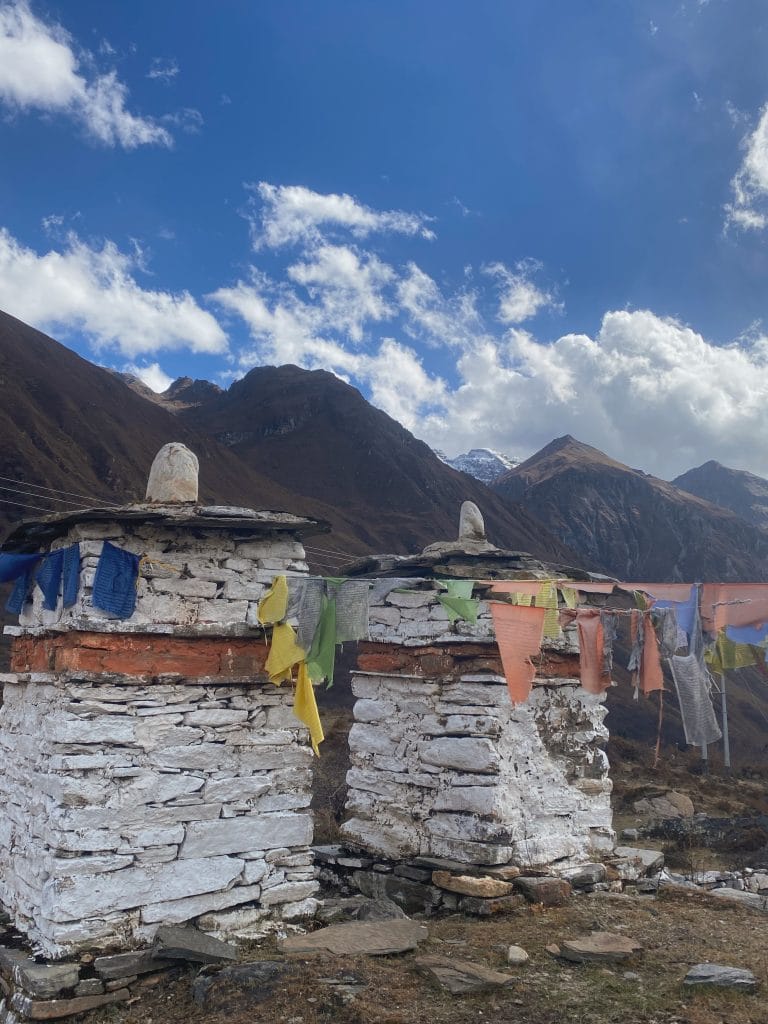
In this project, we expand conventional definitions of heritage to include the ways in which Bhutanese highland communities envision and enact their surroundings; surroundings they co-dwell in and co-create with other-than-humans. Such an approach to heritage involves emphasising ‘imagination’ – referring in an anthropological sense to the diverse and intricate ways in which realities are understood and shaped – anchored in landscapes and places that, as Bhutanese cosmologies teach us, are always at once physical, ecological, cultural, cosmological, historical, and spiritual.
This represents an ontological, epistemological, and ethical legacy, or indeed a people’s heritage, which is primarily intangible and not always confined to specific sites. Rather, it emerges through more-than-human relationships, is enacted into the landscape through ritual and other practices, and is remembered, memorialised, and shared through stories and narratives.
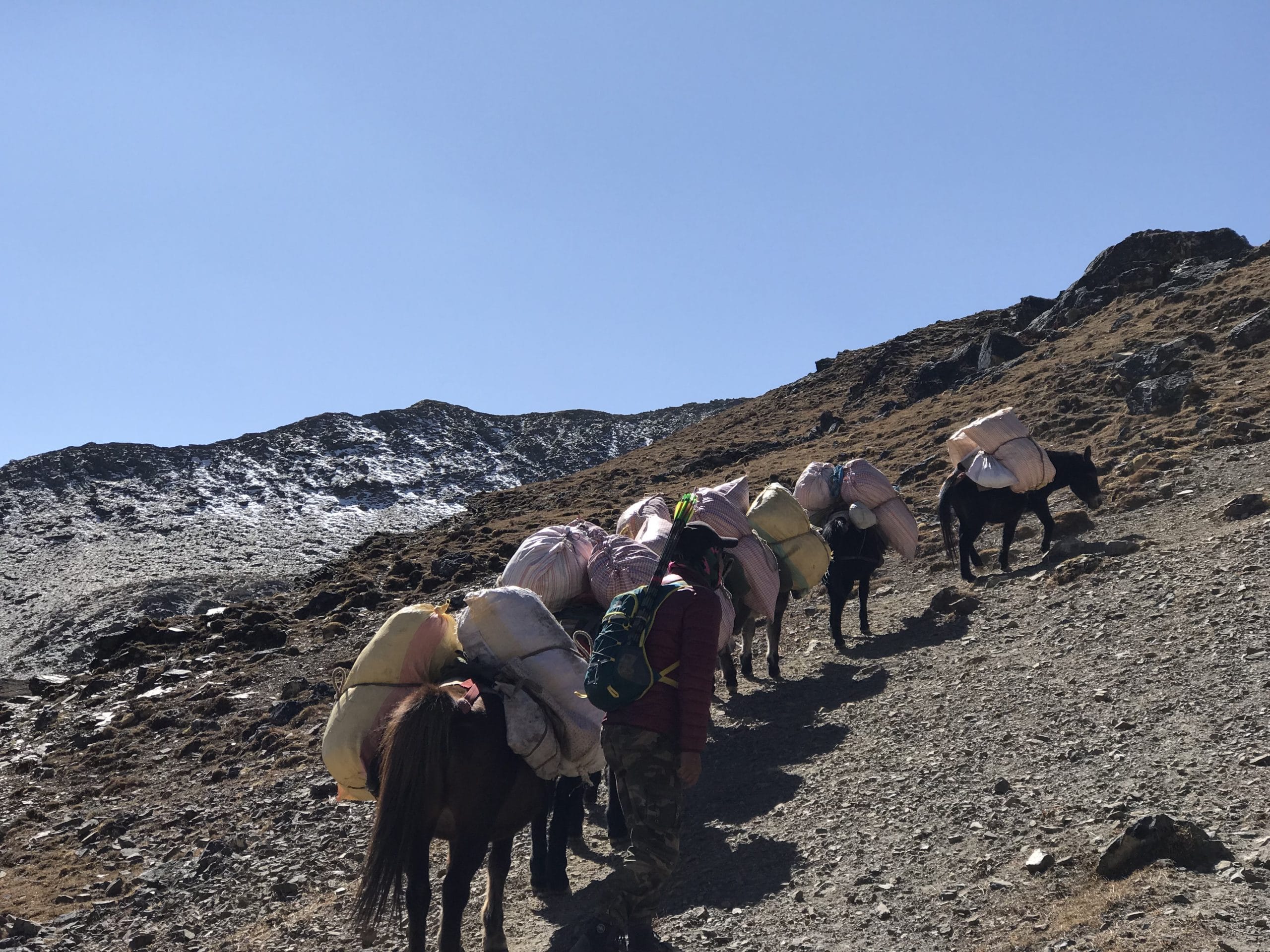
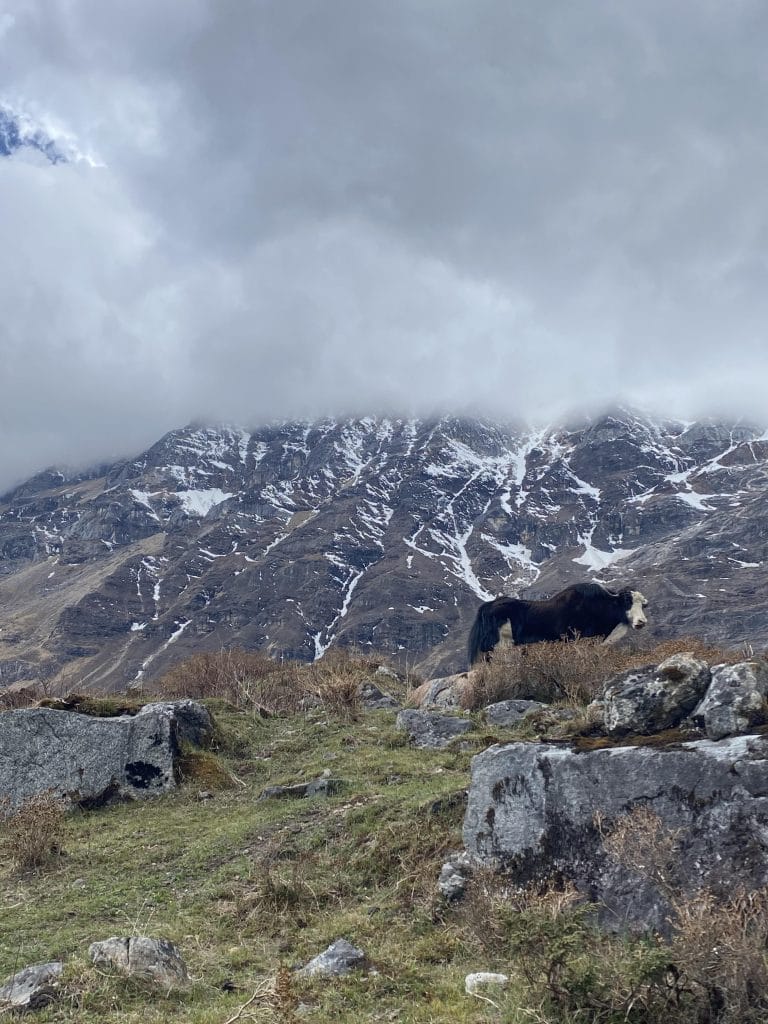
This form of heritage is closely linked to the highlands of Bhutan, a sprawling alpine region that rises above 4,000 metres, where herders and yaks dwell together, alongside horses, bears and other wild animals, plants, cordyceps (a fungus, which is a potent medicine), and various other species. They are also the dwelling places of deities and spirits of many forms and manifestations. The origins and histories of this broad range of dwellers is intimately intertwined, with humans herding yaks, yaks nourishing humans through their produce, deities providing protection to both herders and yaks, and mermaids (tshomen) and other place-based spirits guarding lakes, cliffs, and other landscape elements which the habitation of others depend on. Jointly, these relationships embody tendrel, or interdependent existence, even as the highlands can also be sites of environmental and socio-cultural violence and endings.
By framing these more-than-human worldviews and relationships as more-than-human heritage, the project ‘Perpetuating Highland Heritages of the Bhutan Highlands’, funded by the Gerda-Henkel Foundation, and a collaboration involving the Himalayan Centre for Environmental Humanities (Royal Thimphu College), the Department of Culture and Dzongkha Development (Royal Government of Bhutan), and the Department of Cultural Anthropology and Development Sociology (Leiden University) subverts the scaffolding on which dominant heritage studies is erected.
We approach heritage in its more-than-human and vernacular dimensions, in the sense of foregrounding locally situated highland histories, traditions, and customs, avoiding a predetermination of heritage. Our preliminary findings lead us to affirm as heritage in the Bhutan highlands the complex sets of relationships and values that tie human herders to other species and to the material landscape. As we are learning, more-than-human heritage in the Bhutan highlands is near exclusively orally constituted and conveyed, in dialogue with the environment and the beings which it encompasses, both human and not, living and not.
Historically, herders, monks, and rulers criss-crossed these highlands, co-creating, with their other-than-human companions, a deeply socialised and carefully managed cultural landscape. They have long experienced the geo-ecological and biophysical features of the landscape as ‘texts’ and ‘scripts’ that tell stories, and provide instructions about ethics, morality, cosmology, and social organisation. This project aims to understand and perpetuate these more-than-human texts and scripts.
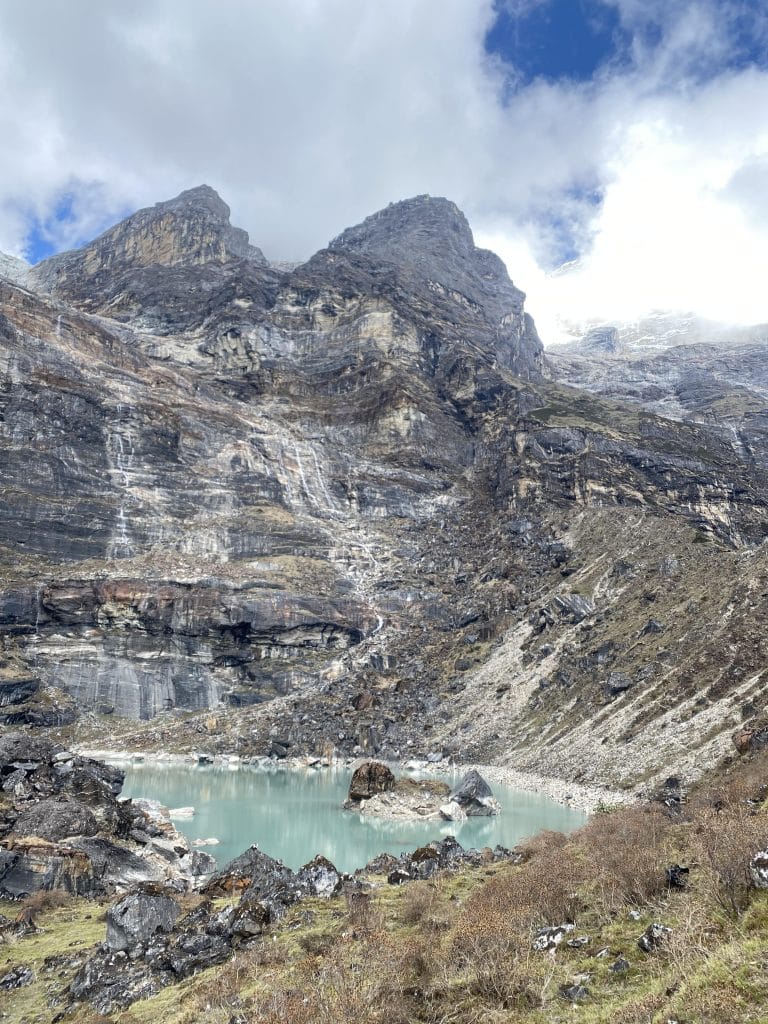
The Bhutan highlands are indeed a landscape of many stories. Each mountain, cliff, and cave is steeped in its own story. Glaciers and lakes are also storied as the embodiment (brtan) and/or abode (gnas) of gods, deities, and spirits, who are deeply invested in human affairs. Stories flesh out the origins, characters, movements, and socially emotive lives of the highlands’ human and other-than-human inhabitants. These stories proliferate as one navigates the landscape, converging in a complex network of interconnected agencies, events, and memories.
The stories also reveal worlding practices, and they fundamentally challenge binary distinctions between self and other, human and non-human, or living and non-living. Instead, highlanders attest to life and death as a continuous, undivided process of mutual nourishment and meaning-creation. The stories invite us to ask: how do we learn to listen and read this more-than-human landscape of the Bhutanese highlands? Who can speak with and represent the more-than-human world? How might we think of these stories, and the relationships they enliven, in terms of more-than-human and vernacular heritage?
The Bhutanese highlands are also a place of change. For most of the 20th century highland herders were fully nomadic. A series of government interventions provided them with permanent settlements, while government departments and services have also extended their reach into the highlands. The commercialisation of cordyceps has provided the Bhutanese highlands with a valuable seasonal resource to be collected. The cash that this brings to the highlands transforms livelihoods, creating new aspirations for what historically used to be a largely money-less economy. With many villages now having an electricity connection, and mobile data connectivity reaching far and high, the Bhutanese highlands are subject to rapid, decisive, and radical change. This has a bearing on what creates community in the highlands, and how that involves humans and other-than-humans alike.
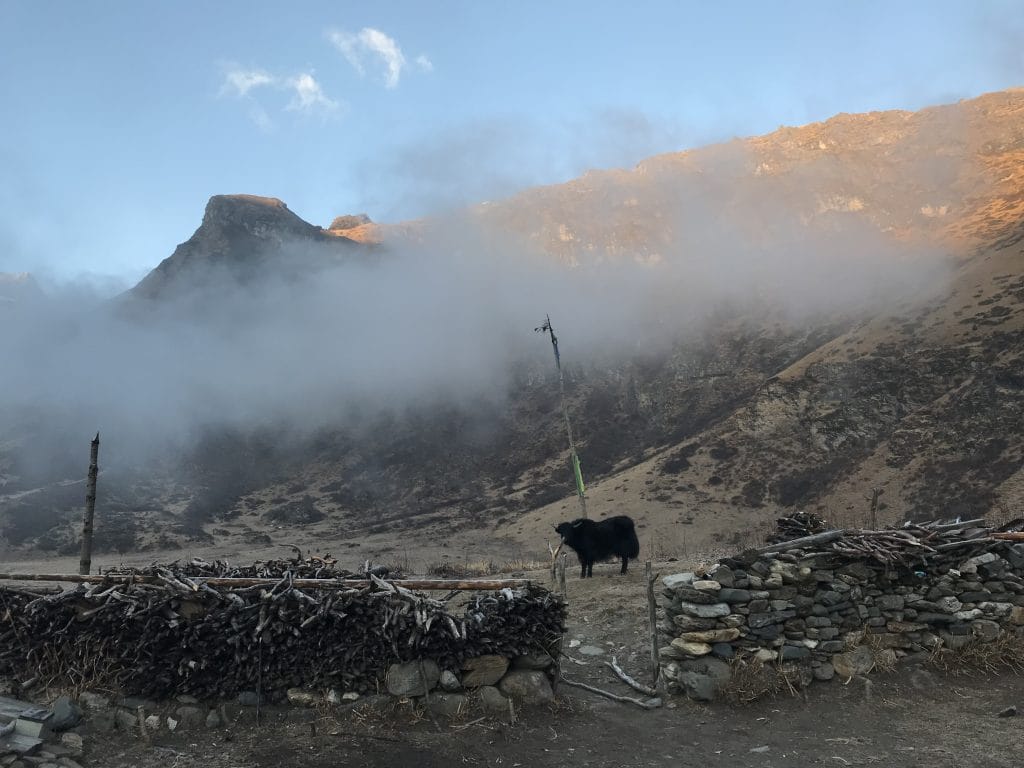
Moreover, Bhutanese herders are already living with the damaging consequences of climate change, even though they may not use the (English-language) concept of climate change to talk about the changes they observe. They are witnessing mountains changing colour, grasslands losing their lushness, lakes either overflowing through floods or drying out because of droughts, yaks altering their migratory routes, and wild animals adopting new behavioural patterns. For the highlanders, climate change is also felt, articulated, and responded to in a cosmological idiom. Known to make their presence felt, and be present in rain, wind, floods, and drought, deities are integral to how climate change is encountered in the highlands. The ongoing disruption of intricate highland systems represents a significant threat – not solely as an environmental concern, but also of time-tested modes of living well with others, most of whom are not human. Said otherwise, climate change poses a direct threat to highland heritages.
As the highlands change, the past gains new significance. Stories, skills and practices, as well as material and ritual objects and techniques are being revalued. People cherish many, are indifferent to some, and want to abandon others. Assessing what derives from the past, in the light of its possible value for the future, involves a process of heritagisation. Currently, the more-than-human, vernacular heritage of the highlands is seldom known beyond the localities where it is manifest. Due to the varied and complex transformations that the highlands are facing, these ideas, traditions and practices are under severe threat.
Our project aims to identify, study, document, and perpetuate the more-than-human heritages of the Bhutan highlands. We are conducting research into the transformative processes taking place in the highlands, and how these reshape people’s interpretation of the past, present, and also the future. We are researching how interpretations of these vary across generations and gender. In its approach, this project combines committed ethnography with audio-visual documentation, with the former preparing the stage for the latter. Anthropologists and sociologists join forces with documentary makers, photographers, and communication and media specialists to understand, document, and disseminate the more-than-human heritage. Ethnography-driven visual storytelling, high quality imagery and documentary footage are means to perpetuate rapidly changing customs and practices while also serving as an educational and cultural resource for current and future generations. Moreover, audio-visual content offers a platform for highlanders to share their perspectives and narrate their own stories, ensuring that heritage is understood and documented from within. This medium not only preserves but also revitalises cultural knowledge, making it more accessible and engaging for wider audiences, including policymakers, scholars, students, and the general public. The project will result in a sustainable digital repository on the Bhutanese highlands, a PhD thesis, and several other academic and popular publications.
*all images courtesy of the Himalayan Centre for Environmental Humanities, Royal Thimphu College.
The opinions expressed are those of the contributors, not necessarily of the RSAA.