The Sinking Ship at the Heart of Conflict in the South China Sea
Bianka Tibayan Venkataramani is a Coordinator of the Global Governance and Security Centre at Chatham House
War today is defined by advanced capabilities – from cruise missiles and stealth submarines, to drone warfare and the weaponisation of artificial intelligence. It is therefore hard to imagine that one of the most strategically significant naval bases in the world is a rusted WWII warship, run aground and slowly sinking in the South China Sea. With holes in her hull and a corroded structure, she stands broken but firm – the first line of defence in the fight for the Philippines’ territorial sovereignty.
Welcome to the BRP Sierra Madre.
This extraordinary ship began her unlikely journey in a rather mundane way, and under a different name, as the USS LST-821 – one of thousands of ships built in Evansville, Indiana for the US Navy in 1944 to bolster the war effort. As a US naval landing ship, she saw extensive action in the Pacific theatre as part of America’s “island-hopping” campaign during World War II. After that tour of duty, she was transferred to the South Vietnamese Navy in 1970 as part of the US military assistance programme. She was rechristened the RVNS My Tho and played a vital role in the riverine warfare that characterised that conflict.
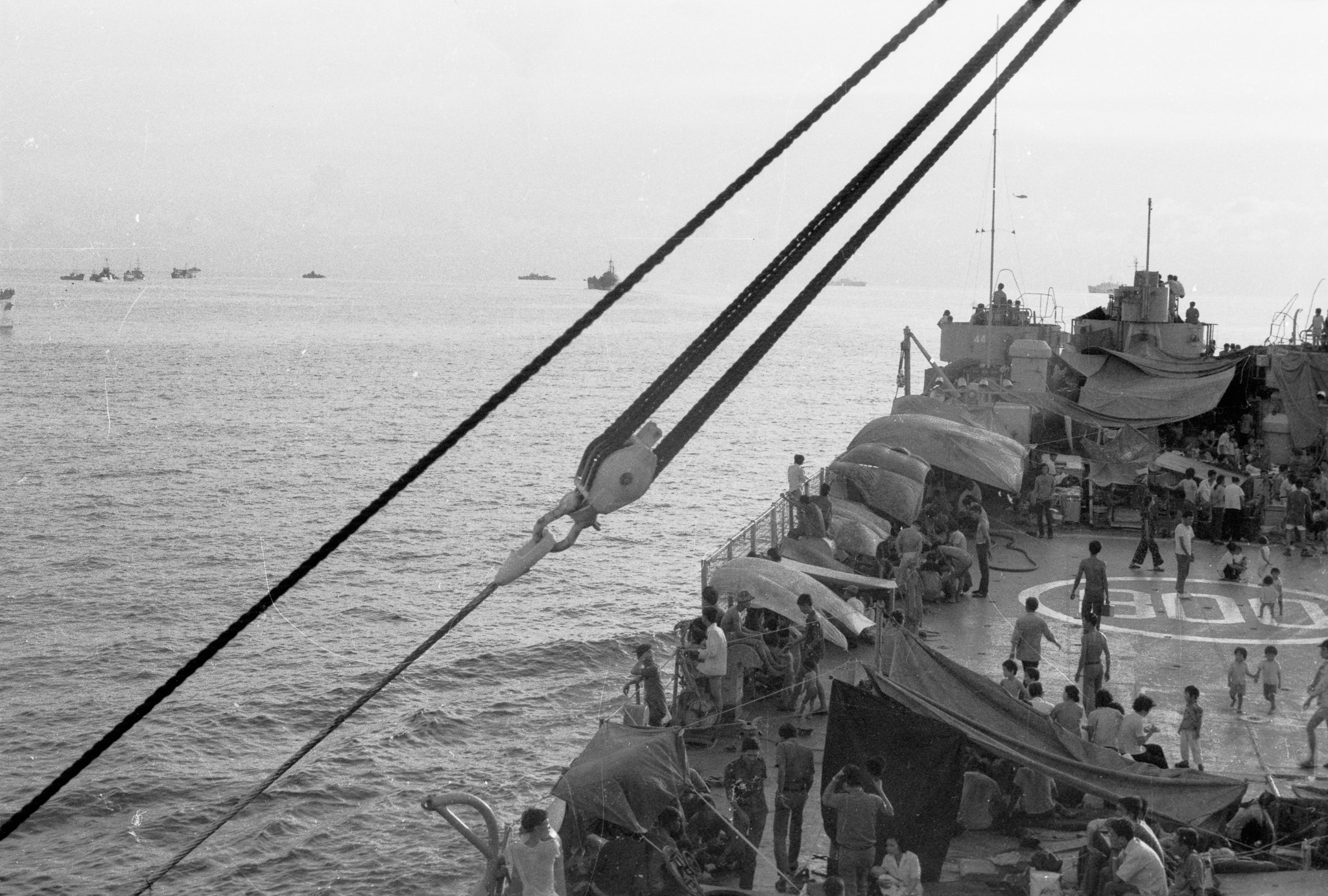
In 1975, she played her biggest role yet, helping evacuate thousands of refugees as she sailed away from Vietnam for the final time towards her eventual home in the Philippines, the result of a deal brokered with the US at the end of the war. Docked in Subic Bay, she received her new name in 1976 and was officially inducted into the Philippine Navy as the BRP Sierra Madre, named after the country’s longest and most significant mountain range.
The next two decades were relatively uneventful, as she served on and off as an amphibious transport ship, until she was finally due to be decommissioned. That is, of course, until one fateful day in 1999. Following the withdrawal of US forces in 1992, a vacuum emerged in the Philippines’ defence capabilities, and Beijing began slowly encroaching into Philippine territory within its Exclusive Economic Zone (EEZ), eventually capturing Mischief Reef – just 129 nautical miles from the Philippine coast and firmly within the country’s jurisdiction. There was growing concern that the Second Thomas Shoal, just 12 nautical miles away, would be next.
And so, Vice Admiral Eduardo Santos, then in charge of the Philippine Navy, came up with an ingenious plan. He arranged for the nearly retired BRP Sierra Madre to make one final voyage – intentionally running her aground on the shoal. Since then, she has served as a makeshift naval base: a permanent military presence defending the Philippines’ territorial rights.
The Second Thomas Shoal is a significant flashpoint in tensions between China and the Philippines. China lays claim to much of the South China Sea, including the strategically important Spratly Islands, the archipelago of which the shoal is a part. While China bases its claims on historical links, the islands and shoal lie within 200 nautical miles of the Philippines and are therefore within its EEZ under the UN Convention on the Law of the Sea (UNCLOS).
In 2014, Manila officially declared the Sierra Madre a permanent installation to support its territorial claim, the same year it filed its arbitral case against China at The Hague. BRP Sierra Madre and her crew are routinely resupplied by Philippine ships and airdrops, and these missions have led to repeated altercations with People’s Liberation Army (PLA) forces attempting to block them. Tensions escalated in 2023 when Chinese forces used water cannons and military-grade lasers to disrupt a resupply mission, prompting formal diplomatic protests from Manila. Despite an agreement in 2024 to de-escalate, pressure remains high.
In March 2026, the Philippine Armed Forces issued a statement that sensitive information regarding personnel and equipment aboard the Sierra Madre had been compromised following an espionage operation involving actors linked to the People’s Republic of China. While no physical damage was done to the base and resupply missions continue, the risk of broader escalation remains significant. Under the Mutual Defence Treaty between the Philippines and the United States, any attack on Philippine territory would obligate a military response from both parties. With Washington increasingly willing to engage in contested regions and Beijing intent on asserting its claims, the waters remain deeply volatile.
And at the heart of it all, we return to the sinking ship.
The BRP Sierra Madre today is far more than a scrappy naval outpost. She has become a symbol of resistance, defiance, and the Philippine spirit of endurance in the face of overwhelming odds. She is sinking and crumbling, and cannot last forever – plans to replace her remain unfinalised, though speculation includes building a permanent structure atop the shoal, or removing her entirely to start anew. While her future remains uncertain, for now she stands.
In a world of great-power competition and the gradual unravelling of the rules-based international order, small states are finding it increasingly difficult to secure space for themselves and defend their right to govern autonomously. The BRP Sierra Madre is a reminder of the importance of perseverance in the face of that reality – a reminder that sovereignty is worth defending, and, above all, that sometimes a measure of ingenuity is all it takes to stand up to a giant.
Title image – HQ-800 (RVNS My Tho) carrying Vietnamese refugees, en route from Saigon to Subic Bay, early May 1975. View from the bridge looking forward. Many refugees and tents are visible on deck. Other ships of the South Vietnamese Navy are visible in the background. Credit – Au Nguyen, DiSD4_03_07.jpg, licensed under CC BY-SA 4.0, via Wikimedia Commons https://commons.wikimedia.org/wiki/File:DiSD4_03_07.jpg
The opinions expressed are those of the contributor, not necessarily of the RSAA.