Rethinking Development in Central Asia

Dr Kuat Akizhanov is Deputy Director of the CAREC Institute and a Visiting Lecturer at the OSCE Academy in Bishkek, Kyrgyzstan
Over the past three decades, Central Asia has undergone a profound transformation. Emerging from the collapse of the Soviet Union, Kazakhstan, Uzbekistan, Kyrgyzstan, Tajikistan, and Turkmenistan were rapidly integrated into a global economic system largely shaped by Western-led institutions and ideas. In this context, development strategies across the region came to be dominated by orthodox frameworks grounded in mainstream neoclassical economics. Market liberalisation, privatisation, deregulation, and export-oriented growth were widely promoted as universal solutions for economic transition and long-term prosperity.
Thirty years on, however, the outcomes of these reforms remain deeply contested. A growing body of scholarship has begun to question the dominance of these approaches and to explore alternative ways of understanding development in post-socialist Central Asia. This article contributes to that conversation by examining the limitations of orthodox frameworks and outlining the case for a more pluralist approach to economic thought and policy.
The Limits of Orthodoxy
In the early 1990s, Central Asian governments, often under the guidance of international financial institutions, embarked on ambitious reform programmes designed to dismantle centrally planned economies and replace them with market-based systems. These policies rested on familiar assumptions: that markets, if left sufficiently free, would allocate resources efficiently; that individuals, acting rationally, would maximise welfare; and that integration into global markets would generate convergence and growth.
In practice, however, these reforms unfolded in complex and historically specific contexts that were poorly captured by such abstract models. While certain macroeconomic indicators improved over time, the broader social and developmental picture has been far more uneven. Rising inequality, persistent regional disparities, environmental degradation, authoritarian political regimes, and fragile labour markets have become defining features of many Central Asian economies.
The limitations of orthodox approaches lie not only in their policy prescriptions but also in their underlying epistemology. Neoclassical economics tends to abstract from questions of power, institutions, and history, treating economies as if they operate in a vacuum. In doing so, it often overlooks the deeply embedded social relations, cultural norms, and political structures that shape economic outcomes. The result is a form of “one-size-fits-all” policymaking that struggles to account for the diversity and complexity of post-socialist societies.
A Case for Pluralism
Recognition of these limitations has prompted increasing interest in more pluralist approaches to development. Rather than relying on a single theoretical framework, such perspectives draw on a range of traditions, including institutional economics, post-Keynesianism, Marxian political economy, feminist economics, and critical realism.
A pluralist approach does not seek to replace one orthodoxy with another. Instead, it emphasises the value of multiple perspectives in capturing the multi-dimensional nature of development. By bringing different analytical lenses into dialogue, it becomes possible to move beyond the reductionism of mainstream economics and to open up new ways of thinking about economic transformation.
Importantly, this perspective also situates Central Asia within a broader postcolonial context. The region’s integration into the global economy has not been a neutral process; it has been shaped by asymmetries of power, knowledge, and institutional influence. Development strategies have often been imported rather than locally grounded, raising questions about intellectual dependency and the marginalisation of alternative knowledge systems.
Rethinking Development Pathways
At its core, this debate raises a deceptively simple question: what might development in Central Asia look like if it were conceptualised differently?
Scholars have begun to explore this question from a variety of angles. Some examine the role of global development institutions in embedding neoliberal policy frameworks, particularly in countries such as Kazakhstan. Others revisit national development models, including Uzbekistan’s distinct approach to transition, asking what lessons can be drawn for the region today.
Comparative perspectives are also instructive. Experiences from ASEAN countries, for example, highlight alternative trajectories of industrialisation and state-led development, suggesting that policy options in Central Asia may be broader than is often assumed. Other analyses interrogate the outcomes of agricultural reforms, questioning whether persistent challenges in the sector reflect market failures, governance deficits, or deeper theoretical shortcomings.
Urban development, finance, and labour markets have likewise come under increasing scrutiny. Concepts such as “klepto-neoliberalism” have been used to analyse patterns of capital accumulation in urban regeneration, while studies of financial expansion point to its implications for social inequality, including in areas framed as women’s empowerment.
These perspectives also draw attention to the cultural and moral dimensions of political economy. Phenomena such as rentierism and neo-feudal social structures underscore the extent to which economic systems are embedded in broader social and ethical frameworks. Development, in this view, cannot be reduced to technical policy adjustments or growth metrics alone.
Beyond Economics as Usual
One of the key insights emerging from this body of work is that economics is not a neutral or purely technical discipline. The ways in which problems are framed – and the solutions that are proposed – are shaped by underlying assumptions about human behaviour, social organisation, and the role of the state.
The dominance of neoclassical economics in Central Asia has therefore had significant implications not only for policy but also for how development itself is understood. By privileging market-based solutions and sidelining alternative perspectives, it has contributed to a narrowing of intellectual space and a depoliticisation of economic debate.
Re-engaging with a wider range of theoretical traditions can help to reopen that space. This includes revisiting the history of economic thought and fostering greater critical reflection on the assumptions that underpin policy decisions.
A Regional and Global Contribution
Although these debates are grounded in the specific experiences of Central Asia, their implications extend beyond the region. Issues such as rising inequality, environmental pressures, social fragmentation, and the limits of market-led development are shared across many parts of the world.
Central Asia’s post-socialist transition offers a particularly valuable lens through which to examine these challenges. It highlights both the consequences of rapid marketisation and the importance of context-sensitive approaches that take seriously the interplay of history, culture, and power.
Taken together, these perspectives point toward a more plural, context-aware, and socially grounded understanding of development – one that moves beyond the assumption of a single, universally applicable model.
The opinions expressed are those of the contributor, not necessarily of the RSAA.
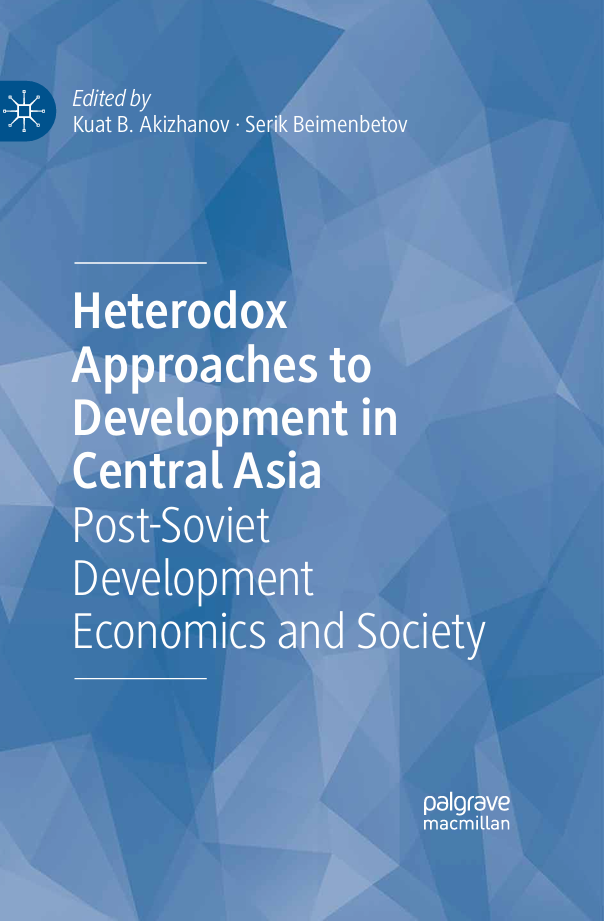
Heterodox Approaches to Development in Central Asia : Post-Soviet Development Economics and Society
This book offers diverse perspectives on Central Asia’s socio-economic development, challenging dominant neoliberal narratives. It reviews three decades of market reforms, foreign investment, and Western-led aid, examining both growth and the drivers of inequality, environmental degradation, authoritarianism, and resource dependence. Drawing on sustainability, postcolonial development, Indigenous knowledge, and social welfare approaches, it proposes alternative pathways better suited to the region’s context. It will interest students, researchers, and policymakers exploring heterodox approaches to development.
Due to be published in October 2026.