A TALE OF TWO CHINAS
Hugh Battye spent fifteen years in mainland China studying Mandarin and teaching English before earning a PhD in ethnology from Lanzhou University in 2020
This piece was first published by ChinaSource on 7 July 2026 and is republished here with permission.
When, as outsiders, we come to think of “China”, we immediately (and usually unwittingly) encounter at least two challenges. The first is how to sum up the diversity of voices found in such a huge country in this singular word, and the second is how to then avoid letting our own natural biases distort our understanding of those voices. My recently published book, A Tale of Two Chinas, seeks to address these challenges by both taking into account the plurality I encountered on my own China journey, as well as aiming to be descriptive, rather than overly prescriptive, with regards to the political and cultural issues that arose on the way. In two words, the book aims to be, as far as possible, holistic and objective.
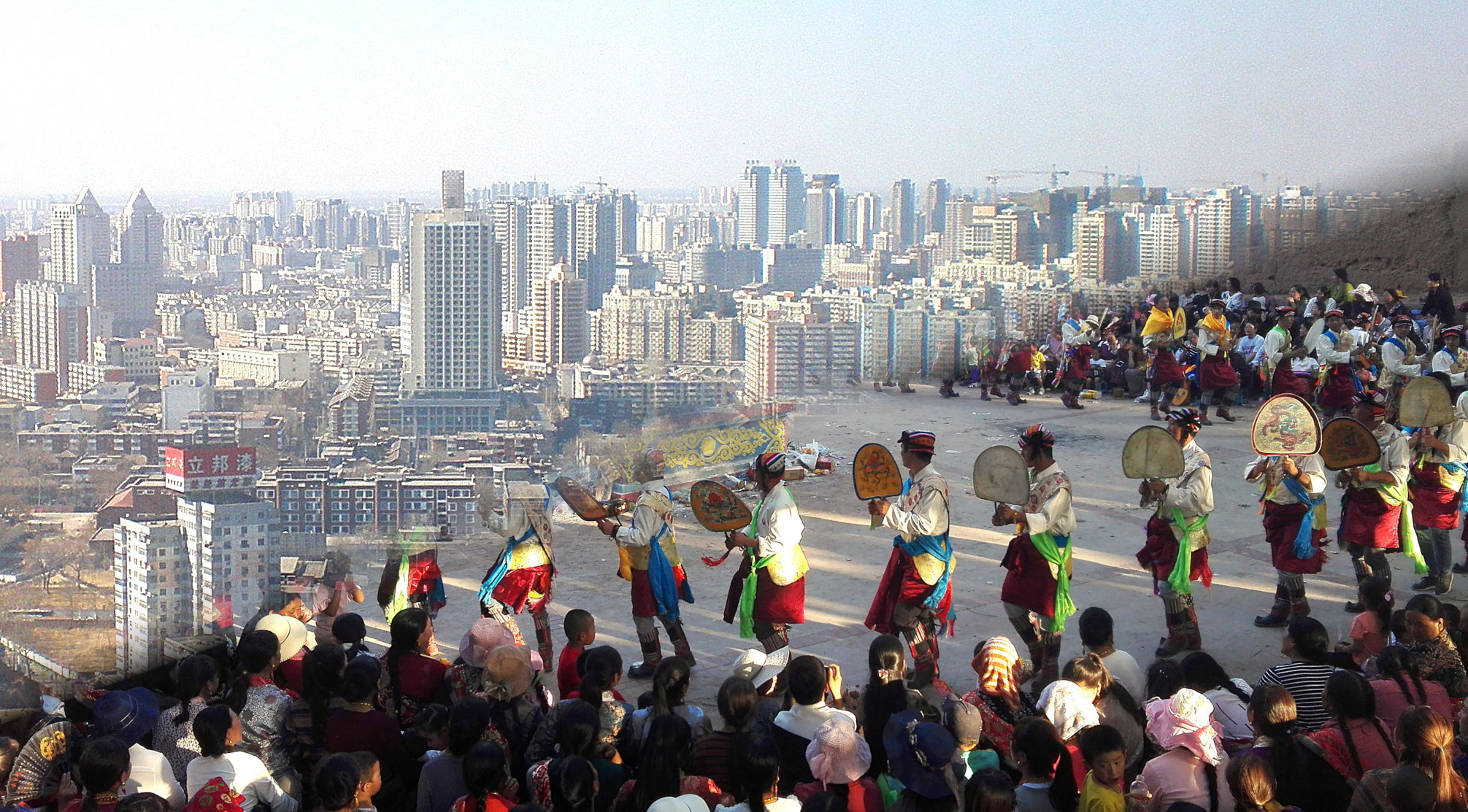
Firstly, holistic. In the book, I divide the account of my fifteen years living in the mainland into two distinct parts, which form my two “Chinas”: firstly, my experiences in what I call “mainstream urban China”, specifically focussing on the three northern cities of Tianjin, Xining and Lanzhou, where I studied Mandarin, taught English, and embarked on a master’s followed by a doctorate in ethnology at a local university. In this first half, tracing my own early China journey, I cover a number of the major political, economic and cultural themes of the reform period, as well as of President Xi Jinping’s current new era. The second half describes what I refer to as “minority rural China”, and is based on the time I spent conducting postgraduate fieldwork among Muslim and Tibetan Buddhist communities in the countryside of the central northwest; in this part I engage in more detail with the social, religious, and agricultural landscape of the particular ethnic groups that I stayed amongst.
Finally, while emphasising the contrast between these two “Chinas” that I experienced, I also note how elements of the two come together in the everyday lives of some of the minority individuals that I knew, who, along with the millions of other migrant workers, manage to maintain a foothold in various camps.
Such an attempt at holism is by no means perfect, not least from an ethnic perspective, where there are, of course, many more than two “Chinas”. Since the founding of the People’s Republic in 1949, the Communist government has delineated fifty-six distinct ethnicities, including the Han – the official name for the Chinese majority, which makes up about ninety percent of the population – and fifty-five minorities. International researchers have, however, expanded those fifty-five into hundreds of ethnolinguistic groups, claiming that many disparate peoples were, often somewhat arbitrarily, merged together during the ethnic classification process in the 1950s. In recent years, furthermore, the concept of one uniform “Han majority” has also come under scrutiny. Is it really the case that 1.2 billion people out of China’s 1.4 are all largely the same? Just taking language and food as examples: as is well known, Mandarin, based on the northern Beijing pronunciation, is far removed from the important dialects of the south, such as Cantonese and Hokkien; while the common expression, “Nan tian Bei xian Dong la Xi suan” – the South sweet, the North salty, the East spicy, the West sour – already gives an indication of the degree of variability in culinary taste within the mainland Han community, even before taking the minorities into account. In the words of the late expert in Chinese Islam, Dru Gladney:
Ethnic differences within Han society, while readily accepted as separate cuisines, cultures, and languages outside of China, within China are regarded as local dishes, customs, and dialects. The Cantonese, Sichuanese, and Hunanese are somehow not what they eat.[i]
Yet at the same time, it is fair to say that much of life and society in China has now been homogenised to a large extent. Official ethnic classification programmes serve not only to define what (the researchers believe) is already there, but by nature also carry elements of creativity and self-fulfilling prophecy. Teach the young people of disparate Chinese communities that they are all part of the same ethnicity, the “Han”, back it up with a strong centralised education system, and they will grow up believing in, and feeling, such homogeneity, passing it on to their children in turn. Combine this with general modernisation, the widespread use of Mandarin, and the proliferation of rapid communication through the internet and social media, and much of Chinese “mainstream urban” life (i.e. my Part One) does, on the surface at least, look quite similar. In relation to Part Two, while my experiences of Muslim and Tibetan Buddhist communities in the central northwest cannot simply be extrapolated to account for the many minority groups noted above, nor do justice to the variegated rural environments that make up the geography of the nation as a whole, I hope that the focus on one particular region offers somewhat of a “micro” balance to the “macro” observations of the first part, as well as painting some broader strokes depicting the China beyond the familiar urban experience. Overall, by navigating the two major fault lines of modern Chinese society – the city and the countryside, the Han mainstream and the minorities – the narrative seeks to provide the space for a more widely reflective picture of China to emerge.
Secondly, objective. Of course, as an outsider and a particular Western Christian, I come to the table with my own biases and perspectives which must be taken into account, as they would in any context. But the stakes are higher when it comes to writing about China, where the current geopolitical climate makes it challenging to try to maintain a relatively neutral stance. As one journalist has noted, China commentators are often branded as “hawks” or “shills”, without much room in between. [ii] Nevertheless, the book does aim at least to take a middle path. Political and religious concerns only surface in the book as they feature within the context of reflection on my personal narrative. Hence, some controversial topics, including, for example, events in Xinjiang and Hong Kong, since they were not a central part of my own experience, are only touched on in passing, a fact which may disappoint some readers hoping for a stronger line on such issues. Others, either from, or related to the mainland, may also be less than happy that I do touch, for a foreign readership, on broader “sensitive” political and religious issues within China as they arise. They, like many in the mainland, would prefer to apply on the national level the Chinese idiom that family scandals should be kept in house. [iii] To them I would answer with Oliver Cromwell, that a good portrait should not only illustrate the attractive features but include, famously, “warts and all”.
Perhaps, however, if I disappoint on both sides, then to some extent the book will have achieved its purpose. For, as indicated above, its aim is neither to attack China, nor to defend China, but to describe China – or rather the Chinas, that I experienced, in all their glories, joys, challenges and struggles. In any case, if, as Solzhenitsyn claimed, the separating line between good and evil lies within each human heart, how much harder to make confident moral assessments on the second most populous nation on earth? [iv] Such assessments will, of course, still be made, and it is therefore my hope that this book will help to inform readers of whatever persuasion, as they continue to forge their own understanding on the gargantuan, fascinating, and complex entity that is the twenty-first century People’s Republic of China.
[i] Dru C. Gladney, Muslim Chinese: Ethnic Nationalism in the People’s Republic (Cambridge, Massachusetts: Harvard University Press, 1991, 1996), 306.
[ii] Cindy Yu, “I’d be the Perfect Communist Shill,” The Spectator, 27 August 2022, https://www.spectator.co.uk/article/i-d-be-the-perfect-communist-shill.
[iii] Jia chou buke wai yang 家丑不可外扬.
[iv] India officially overtook China in 2023.
The opinions expressed are those of the contributor, not necessarily of the RSAA.
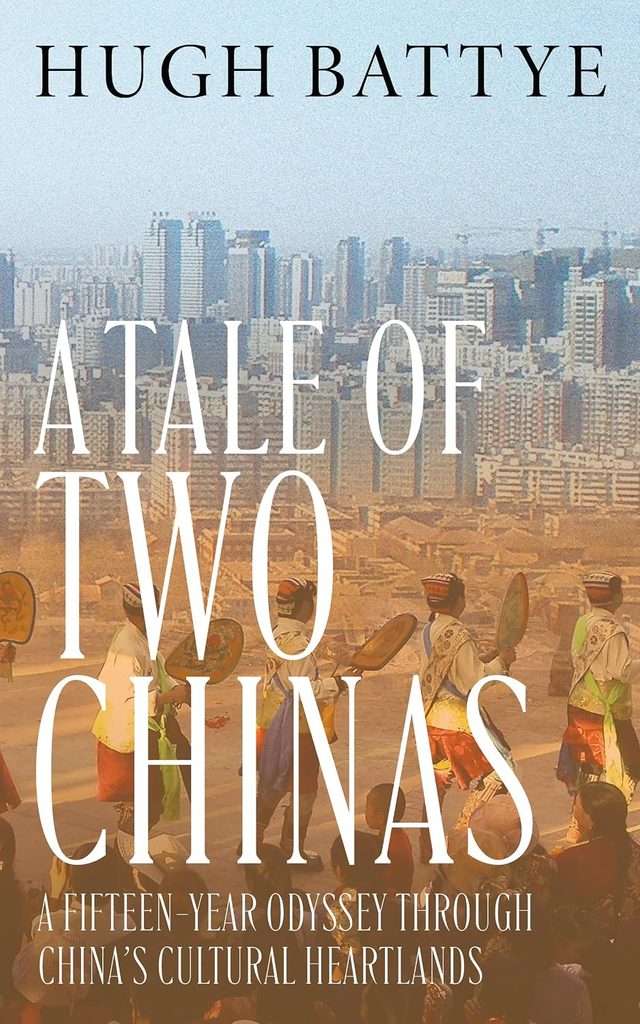
The Tale of Two Chinas: A Fifteen-Year Odyssey Through China’s Cultural Heartlands
A Tale of Two Chinas is essential reading for anyone seeking a deeper understanding of China in the early-mid twenty-first century. Based on Hugh Battye’s own compelling fifteen-year China journey, the book takes the reader on a topical odyssey, covering many of the major economic, political and cultural themes of the later Reform years, as well as of President Xi Jinping’s current New Era. Through the vividly contrasting, yet complementary, descriptions of the “two Chinas” he experienced – the sophisticated society of the Chinese urban mainstream on the one hand, and the vibrant Muslim and Tibetan Buddhist minority cultures of the rural northwest on the other – the author provides a fresh, holistic and accessible account of a country that, despite its superpower status, still remains largely opaque to many in the non-Chinese-speaking world.