Governor, Traveller, Scholar, Spy: The Career of Sir Cecil Clementi
Graham Hutchings is an author and Honorary Professor at the School of Politics and International Relations, University of Nottingham
In 1925, Hong Kong was facing the biggest crisis in its more than 150-year history as a British colony. China was convulsed by revolution – not the comparatively gentlemanly affair that had toppled the Manchu Qing dynasty in 1911 – but a violent campaign to unite the country and end the foreign presence. Strikes, protests, and the shootings of demonstrators by foreign police, notably in Shanghai in May and Canton in June, raised popular sentiment to fever pitch across the country.
The newly formed National Government in Canton, armed, financed and advised by Soviet emissaries, was the political headquarters of the national revolution. Under Chiang Kai-shek, the National Revolutionary Army was preparing to embark on the Northern Expedition and topple the so-called central government in Peking as well as the warlords who stood in the way. The treaty port privileges enjoyed by foreigners, especially the British, would be abolished. China would become a unified, truly independent nation.
British Hong Kong – the first as well as the most egregious symbol of the humiliating ‘unequal’ treaties China had signed in the nineteenth century – was a prime target for China’s new breed of revolutionaries. In June 1925, seamen in Canton and Hong Kong launched a boycott that brought trade between the two places to a halt. Workers downed tools in Hong Kong, many deserting the colony for Canton, where they received financial as well as political support. Economic life came to a virtual halt. The authorities declared an emergency and begged London for a credit line to keep Hong Kong afloat. British rule hung by a thread.
At this juncture, the government in London decided to replace Governor Sir Reginald Stubbs with a man thought better equipped to deal with the crisis. He was Cecil Clementi, who in November 1925 became the 17th governor of Hong Kong. He is the subject of my new biography, the first to examine every aspect of this extraordinary man’s career as a governor, traveller, scholar and spy.
Clementi got the job because of his acknowledged understanding of China and its culture. This was the fruit of the 13 years that he had already spent in Hong Kong, beginning with his arrival in the territory as a government cadet in 1899.
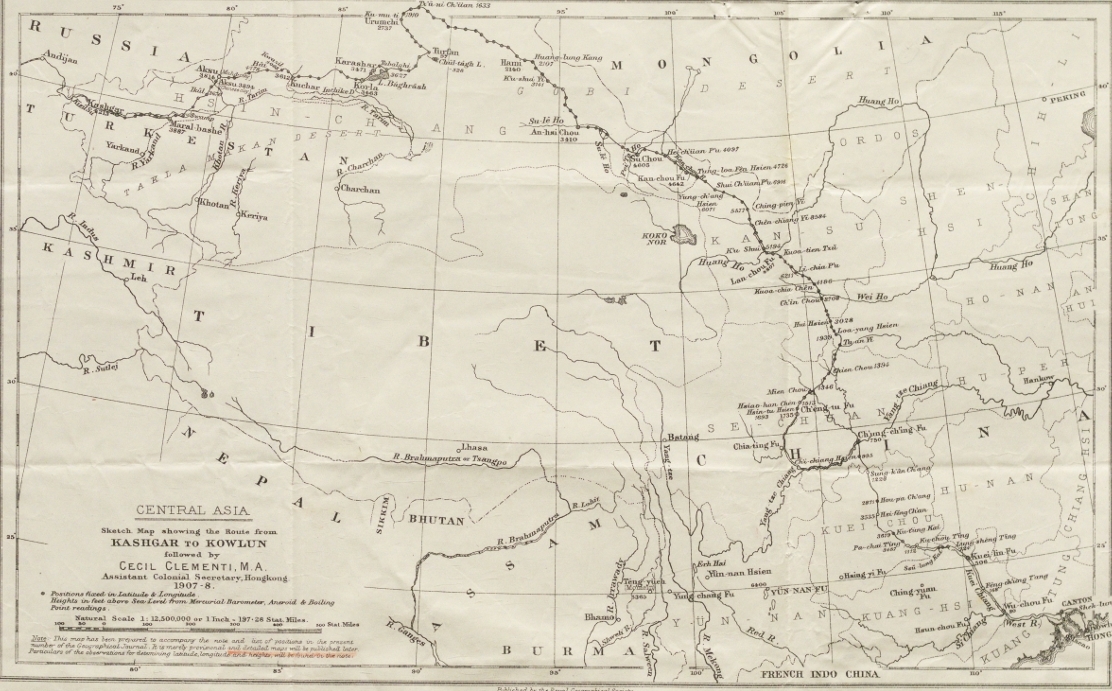
He had quickly mastered Chinese, published a translation of Chinese poetry, played a major role in the land settlement in the leased New Territories, helped found Hong Kong University, and contributed to operations on the newly built Kowloon-Canton railway. He had also found time to undertake a series of travels in China, including in 1907-1908, a remarkable ‘long march’ from Kashgar to Kowloon, the final leg of an overland journey from London back to Hong Kong.
For all his acknowledged brilliance, Clementi had found it impossible to secure promotion in the Hong Kong government. His only way up the colonial hierarchy was to accept the post of colonial secretary in British Guiana, Britain’s only colony on the South American mainland and an imperial backwater compared with Hong Kong.
Cecil and his new wife Penelope did not take to the country, people, or climate in his new posting. But he published a book on the colony’s small Chinese community and wrote another on the history of its unique constitution. This was so sensitive a topic that London ordered him not to publish the manuscript until after his retirement.
But Clementi’s official duties aside, the couple were hardly inactive. In 1916, they completed the physically challenging ascent of Mount Roraima, the flat-topped mountain on the borders of British Guiana, Venezuela and Brazil. Penelope was the first woman to do so.
In 1921, Clementi escaped British Guiana for the more agreeable post of colonial secretary in Ceylon. He was back East again. Much of his time was spent wrestling with a new set of challenges arising from political reform in what was regarded as the ‘model’ Crown Colony. Before long he set his sights on a return to Hong Kong – this time as governor.
The call came in August 1925. Hong Kong was now one of the trouble spots in the Empire. Secretary of State for the Colonies Leo Amery appointed Clementi as governor ‘on the double ground of his intimate and quite exceptional knowledge of the Chinese and of his general ability and judgement.’
This was a reasonable view to take of a man who, at 50, was still energetic, a competent administrator, scholarly in temperament, perhaps rather aloof, but fond of China and the Chinese. There were surely few better candidates for such an exacting job on the frontline of the battle between the Empire and its enemies.
Yet the government in London soon had cause to regret Clementi’s appointment. The root of the problem was that China was now a very different country from the one that Clementi had come to know so well in the first decade of the twentieth century.
Revolutionary sentiment was sweeping through the major ports and cities, especially among the young. Bolshevik influence was widespread. Anti-foreign feeling threatened the survival of the great centres of international influence in China – Shanghai and Hong Kong – as well as the lesser concessions and treaty ports. And China’s intellectuals were engaged in a campaign of cultural iconoclasm known as the May Fourth Movement, the aim of which was to destroy much of China’s traditional culture and embrace the new creeds of science and democracy.
Clementi was intellectually ill-disposed towards all these developments. He was particularly opposed to Bolshevism, which he regarded as a form of barbarism that posed a direct threat to the British Empire. China had fallen prey to the ‘flaming nationalism that is now worldwide.’ The problem, as he saw it, was that the British government, in trying to come to terms with the new situation in China, was ready to give away hard-fought ‘rights’ that might well include Britain’s possession of Hong Kong.
In Clementi’s own words he was a ‘voice crying in the wilderness’. The government in London had its eyes on its future relations with China rather than the welfare of Hong Kong. And it looked askance at criticism from a colonial governor, however able he might be. He was told not to ‘butt in.’ It was the Foreign Office’s job to set Britain’s policy, not the head of the Hong Kong government.
Clementi at first sought to end the Guangdong–Hong Kong strike boycott by negotiation. When that failed, the Royal Navy intervened, forcing the government in Canton, by now preoccupied with supplying its troops on the Northern Expedition, to end the protest. Relations between Canton and Hong Kong, those twin poles of the Cantonese-speaking, commercial world of South China, soon improved. In 1928, Clementi made a successful visit to the city whose leaders had once threatened to cut the throat of the British colony.
In Hong Kong itself, Clementi was determined to make Hong Kong more like the ‘old’ China than the ‘new’. He was not short of allies. They included the elders of the New Territories, who had no interest in calls for land reform coming from Canton; local business elites, happier to put profits before politics; and a group of exiled Chinese intellectuals whose traditional learning was no longer wanted across the border but who responded warmly to Clementi’s initiative to set up a school of Chinese studies in Hong Kong University with the avowed aim of preserving the ‘best’ of Chinese culture.
In this respect as in others, Clementi was a cultural relativist as well as a conservative. He put British interests first, as one would expect of a devoted servant of the state. But he believed that Britain’s interests were compatible with those of Hong Kong’s Chinese population – if the latter were properly handled. To this end, he appointed Chow Shouson as the first Chinese member of the colony’s Executive Council and increased the number of unofficial members of the legislature.
Yet unbeknown to the Chinese elites with whom he collaborated so closely, he repeatedly called on London to annex the New Territories which, in 1898, Britain had leased from China for 99 years. Otherwise, as he put it in a private letter in 1930, “I very much fear that, at the close of this [the twentieth] century, some British cabinet, adopting the lines of least resistance, will make a present [of Hong Kong] to China.”
The British government at the time had no appetite for annexing more Chinese territory. It was against the spirit of the age and was sure to provoke uproar in China. Thus, in the very different circumstances of 30 June 1997, Clementi was proved right: Britain did indeed ‘make a present’ of Hong Kong to China.
In 1930, Clementi left Hong Kong a disappointed man, even though he had genuine achievements to his name. Apart from establishing closer relations with leaders of the local Chinese community, they included getting key infrastructure projects underway such as the legendary Kai Tak airport and Hong Kong’s modern water supply.
And Clementi’s career was not over. He was moved from Hong Kong to take on the role of Governor of the Straits Settlements and High Commissioner of the Federated Malay States. He did so at an extremely challenging time: the worldwide depression quickly sucked the life out of the tin and rubber industries that had made Malaya rich by comparison with other parts of the world. The economic situation did not improve until the eve of his departure into retirement in 1934.
The moment he arrived in Singapore, Clementi moved to suppress all expressions of nationalism among the Chinese community. He insisted that local Chinese owed allegiance to Britain, not the new government in China. London complained that it had not been consulted before Clementi undertook his crackdown. China accused Clementi of being anti-Chinese. Negotiations between Britain and China on the sensitive issues of extraterritoriality stalled.
Clementi sought to counter the growing influence of China and the Chinese in the Malayan peninsula by other means, notably his signature policy of decentralising power in the Federated Malay States. His aim was to increase the power of the Malay sultans and their State Councils in their ancestral homeland. It was a British obligation so far honoured in the breach, he insisted.
But Clementi’s policy provoked uproar among businessmen as well as many local Chinese. The former feared that decentralisation would impair the administrative efficiency that they needed to get things done. The latter, along with some Britons in Malaya and in London, wanted more democracy rather than a Malay theocracy-cum-autocracy, however benign this might prove.
Clementi pressed ahead regardless until Secretary of State for the Colonies Philip Cunliffe-Lister lost patience. He told Clementi that he could no longer be trusted to carry out the policies of the British government in Malaya. He would not be allowed to return to the country once his home leave was over in 1934.
By this time, Clementi was suffering from diabetes. Back in London, he had begun the still quite novel treatment of insulin injections. His failing health provided convenient grounds for the Colonial Office to announce his retirement. It was a sad end to the career of one of the most talented and extraordinary figures of Empire, albeit one who often found himself at odds with the times.
The opinions expressed are those of the contributor, not necessarily of the RSAA.
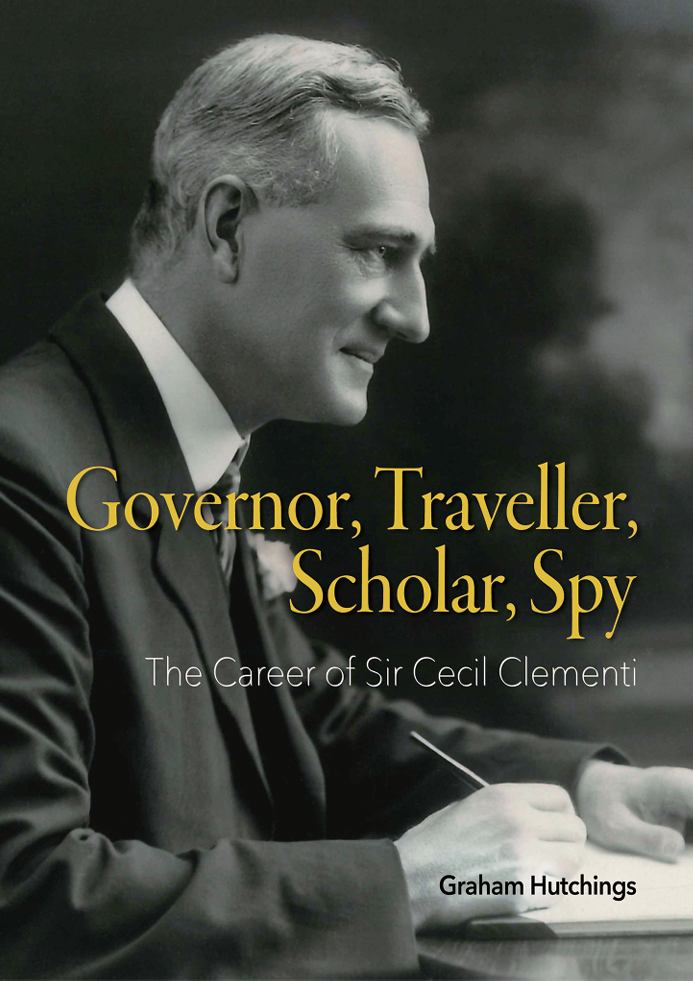
Governor, Traveller, Scholar, Spy: The Career of Sir Cecil Clementi
Hutchings traces the career of a gifted but controversial colonial administrator who governed Hong Kong and the Straits Settlements during a period of political upheaval. A fluent Chinese speaker, Clementi undertook intelligence-gathering journeys across China, helped establish Hong Kong University, championed the development of Kai Tak airport and the city’s water supply, and appointed the first Chinese member of Hong Kong’s Executive Council. Yet his commitment to traditional Chinese and Malay culture, alongside his resistance to political reform ultimately forced his early retirement. This first full-length biography of Clementi explores his significant role in Hong Kong’s history and offers fresh insights into the administration and complexities of the British Empire.