Jordan’s Unquiet Streets
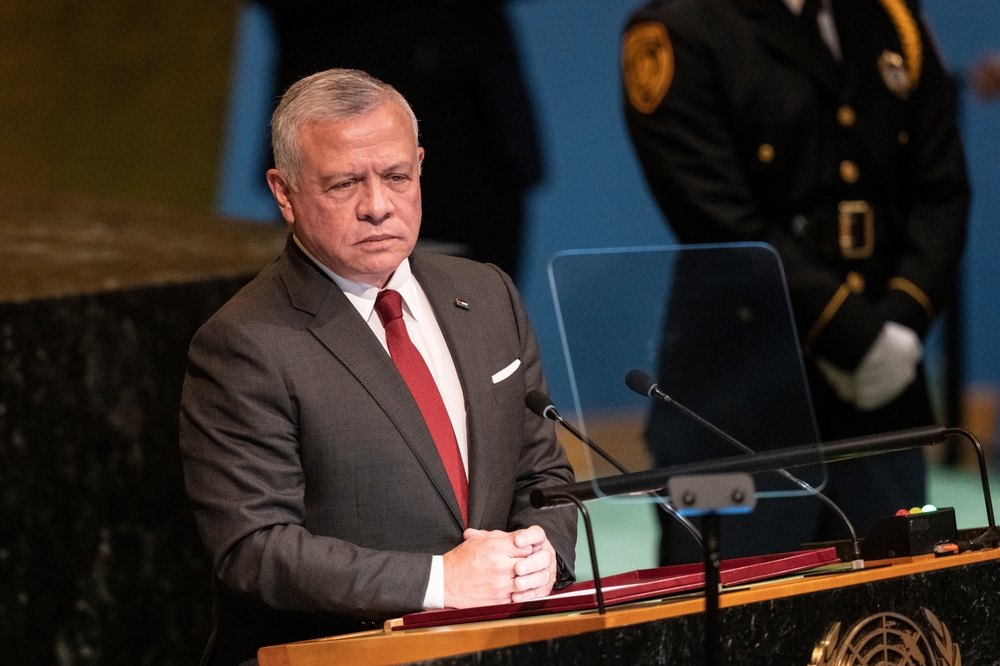
Jillian Schwedler is a Distinguished Professor of Political Science at Hunter College and the Graduate Center, City University of New York
For an authoritarian country, Jordan sees a large number of protests that are only rarely repressed with lethal force. In Protesting Jordan: Geographies of Power and Dissent, I document tens of thousands of protests dating from the 1860s, during Ottoman rule, through to the creation of Transjordan and later independent Jordan, and up to the present. Two key insights about that long durée help place the waves of protest in recent years in context – as well as the regime’s response to them.
First, the regime is reluctant to violently repress protests particularly when they are mounted by Jordanians of East Bank descent – the portion of the population who date their residence in the Transjordanian area (the lands east of the Jordan River and south of Greater Syria) to before the Great Arab Revolt of 1916. Most but not all of this group maintain some level of tribal affiliation, although what that means in practice varies considerably across space and generations. When Abdullah I – son of Sherif Hussein of Mecca, the leader of the Great Arab Revolt – declared the Emirate of Transjordan in 1928 with British colonial backing, many of the indigenous communities objected to his rule as an outsider. Others embraced Abdullah as preferable to Ottoman or British rule, though in practice the fledgling state was established only through British largess. This background remains important to understanding the regime’s reluctance to use violence against East Bank protesters today because that founding moment was and is still called a “social pact,” in which the East Bank communities accepted Abdullah’s rule in exchange for status, jobs, and some semblance of social welfare. While many East Bankers stridently opposed the Hashemite regime and its British backers, steadfast support also came from within this community and remain a bedrock of the regime’s support base today.
Second, that social pact was unsettled with the creation of the state of Israel when hundreds of thousands of Palestinians were forced or fled east into the West Bank and across the Jordan River into the Hashemite Kingdom. By then named king of a formally independent Jordan (although the British still controlled the army), Abdullah saw the Nakba as both tragedy and opportunity, seizing control of the West Bank and then formally annexing it a couple years later. While Jordanians have been steadfast in their support for Palestinians and their right of return, a nativist nationalist trend emerged that maintained that Palestinians were outsiders even as the king granted most of them citizenship.
Anti-Israeli Protests in Recent Decades
The issue of Palestine has, since the 1930s, driven Jordanians to the streets in protest. While most of these protests are tolerated because solidarity with Palestinians is shared by the regime, most other protests were harshly repressed during Jordan’s period of martial law from 1957 through to the 1980s. At the outbreak of the First Intifada in 1987, however, Jordanians took to the streets nationwide in solidarity. A more permissive environment emerged following massive economic protests in 1989, which are credited with ushering in a new period of political liberalisation in the 1990s. Thus, when Jordan signed a peace treaty with Israel in 1994, political parties, activists and members of professional associations joined with a few prominent former government officials in opposition to the normalisation of political and economic relations with Israel.
With the start of the Second Intifada in late 2000, Jordanians again took to the streets in solidarity, the first major protests under the new King Abdullah II (great-grandson of Abdullah I) who ascended in 1999. Many protests of this new wave began to gather less than a kilometre from the Israeli embassy at the Kalouti Mosque in the Rabia neighbourhood of West Amman. Framed as “marches on the Israeli Embassy,” these protests followed a familiar routine in which demonstrators met a line of riot police (the Darak Forces, or gendarmerie) along a given street but did not actually try to reach the embassy. The protests were largely tolerated so long as the protesters followed the implicit agreement, namely, performing their “march” but not actually trying to reach the Israeli embassy (or the US Embassy in the neighbourhood of Abdoun).
With each major Israeli incursion into the West Bank or Gaza, however, these smaller, routine protests ballooned to tens of thousands nationwide. The massive crowds and roadblocks brought traffic to a standstill but eventually subsided, usually after a few weeks. Jordanian activists have also taken other actions to target Israel and the Jordanian regime’s relations with it. A campaign against Jordan’s gas deal with Israel in 2014, for example, sparked a focused movement drawn from anti-normalisation activists under the slogan “The Gas of the Enemy Is Occupation.” Despite the campaign gaining support from parliamentarians, however, the government went ahead with the gas deal, which came into effect on January 1, 2020.
Post-October 7 Protests
Following the Hamas attacks on October 7, 2023, Jordanians again took to the streets in large numbers nationwide against Israel’s subsequent war on Gaza. The largest protests took place in northern cities with sizable Palestinian refugee populations, such as Amman and Irbid. In the capital, protesters gathered weekly near the embassies of Israel and the United States. Although not welcome by the regime, these protests were largely tolerated because they align with its opposition to Israel’s actions. The king swiftly and strongly criticised Israel’s severe retaliation, even while it continued to do business with it. In November 2023, Jordan briefly expelled the Israeli ambassador from Amman. Yet such largely symbolic actions were sidelined by the maintenance of economic and military cooperation with Israel and the United States. This hypocrisy is not lost on activists, even as speeches by the king and foreign minister are often met with cheers from ordinary Jordanians.
But the post-October 7 protests were not all routine. When angry protesters have tried new tactics, they have been met with swift resistance from the police using tear gas, rubber bullets, water cannons, and batons – an escalation but still largely non-lethal. In mid-October, some protesters tried to reach the border between Jordan and Israel in the Jordan River Valley, but police stopped them before they could get close. Following an October 17 strike on Al Ahli hospital that was attributed to Israel, hundreds of Jordanians gathered at a new location near the Chinese Embassy and tried to march on the Israeli Embassy from there. Whereas the protesters who followed the established route near the Kalouti Mosque initially encountered less police violence, those at the new location were confronted by several hundred police officers using tear gas and heavy barricades to turn back the marchers.
For nearly two years after October 7, 2023, the size and frequency of protests fluctuated, and tensions among some of the familiar groups at anti-Israeli protests have increased. In one protest in downtown Amman in November 2023, for example, some leftist activists clashed with Muslim Brotherhood protesters over whether the flags of political parties should be carried alongside Palestinian and Jordanian flags.
The war on Gaza has also reenergised communities with longer histories of political activism that had become subdued in recent years. One particularly notable protest was organised by residents of the Hayy Tufaylah neighbourhood in Amman, where many have roots in the southern East Bank town of Tafileh. As in other East Bank towns, such as Karak and Ma`an, Tafileh residents are proud of their long history of resistance to Ottoman, British, and Jordanian authorities and their lack of fear in criticising the regime. These are among the East Bank communities that the regime counts as both a loyal support base and a source of outspoken criticism when they feel that the regime has violated the long-standing social pact.
Evolving Regime-East Bank Relations
As numerous Israeli officials openly discuss plans to depopulate Gaza and the Arabic media broadcast images of the devastation, Jordan’s government and citizens alike fear that Israel and the United States will pressure the country to accept another large wave of Palestinian refugees. Jordanians are watching closely to see whether the king will be able to resist pressure from Israel and the United States, which provides the kingdom with some $1.5 billion in annual aid. They are also voicing longstanding grievances against the monarchy’s normalisation with Israel.
But despite the social pact, the regime is showing signs of being increasingly intolerant with protests, even those supported by substantial numbers of citizens of East Bank dissent.
Even though recent waves of protests have not directly threaten the Hashemite regime or challenged the king’s rule, the regime has steadily escalated its crackdown on activists, not least through the long-term house arrest of the popular Prince Hamzeh for his outspoken criticism of the regime, suggesting that the king is increasingly worried about political opposition to his rule. With the outlawing of the Muslim Brotherhood – a group that was careful to not cross regime redlines during protests – and the passage of a new cybercrimes law that allows the regime to arrest, for example, anyone who criticises the regime or a foreign ally (e.g., Israel or the United States), the Hashemite regime seems to be seeking to end Jordan’s centuries-long history of protesting as a means of engaging in dialogue with those in power. The regime has the upper hand, at the moment, but Jordanians can be fierce in asserting their dissent – the next wave of massive protests may be right around the corner.
The opinions expressed are those of the contributor, not necessarily of the RSAA.
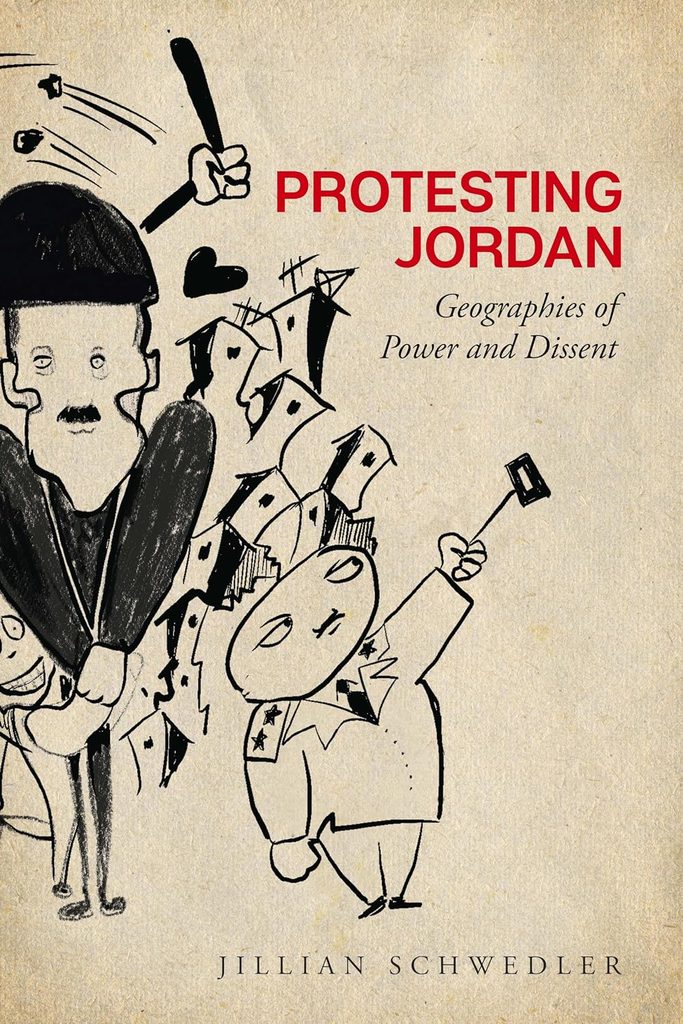
Protesting Jordan: Geographies of Power and Dissent
Protest has been a key method of political claim-making in Jordan from the late Ottoman period to the present day. More than moments of rupture within normal-time politics, protests have been central to challenging state power, as well as reproducing it – and the spatial dynamics of protests play a central role in the construction of both state and society. With this book, Jillian Schwedler considers how space and geography influence protests and repression, and, in challenging conventional narratives of Hashemite state-making, offers the first in-depth study of rebellion in Jordan.