Saudi Arabia’s weak link: Yanbu and Vision 2030
Thomas Boeder FRAS is an Army Scholar reading Middle East Studies and Modern History at the University of St Andrews
The war in the Gulf has not been kind to Mohammed bin Salman (MBS), the crown prince of Saudi Arabia. The Vision 2030 project, launched ten years ago to wean the Kingdom off oil and open it to international tourists and investors, now looks like the phantasm of what might have been possible in a peaceful region.
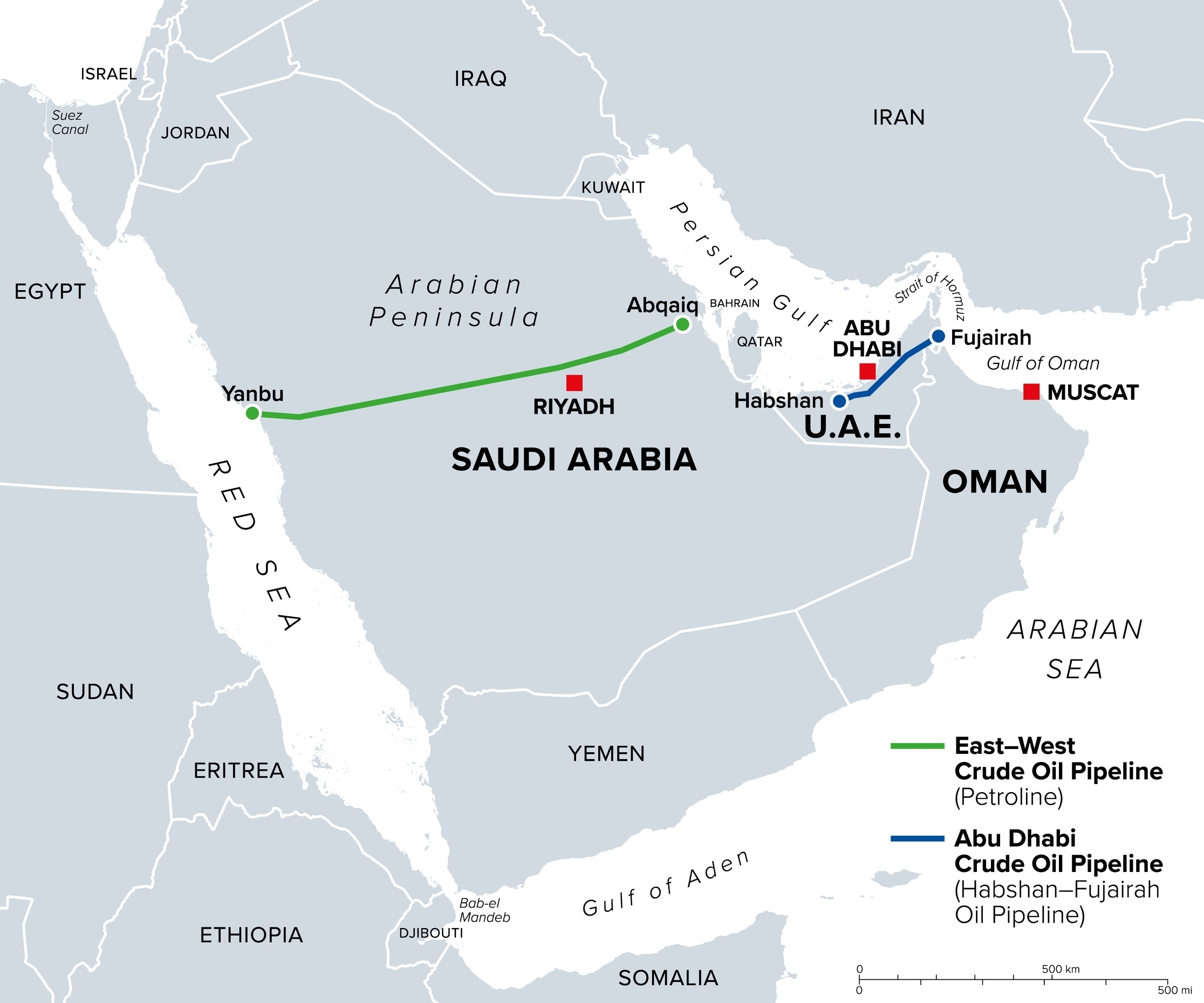
Since Iran first closed the Strait of Hormuz in February, much of the revenue that pays for Vision 2030 has been funnelled through the industrial city of Yanbu on the Red Sea coast. The port, which loaded roughly 750,000 barrels per day (b/d) before the war, was exporting 4 to 4.5 million b/d in early September. This export route is now under pressure from the Houthis and Iraqi militias, and the Saudi forces defending the city have had to call on a patchwork of foreign supporters. A programme designed to end the Kingdom’s dependence on a single commodity depends largely on a single port, the only Saudi crude outlet beyond Tehran’s control and well within range of its allies.
A strategic liability
Each time Hormuz has closed, Riyadh has fallen back on the East-West pipeline, or Petroline, which carries crude 1,200 km from the Eastern Province to Yanbu. Built in the early 1980s, the line was upgraded in 1987, during the Tanker War, as insurance against a closure of Hormuz.
Before any question of defence arises, the pipeline is already constrained by capacity at Yanbu. In March some 87% of Saudi crude exports left through the port, and in the first half of July the share was still about three quarters. The problem is that although the line can pump up to 7 million b/d to Yanbu, its terminals can load only about 5 million b/d. Even at its target rate, the Red Sea route would leave Saudi exports some 2 million b/d below pre-war levels.
The Houthis entered the war at the end of March, and on 20 July declared a maritime embargo on Saudi Arabia. They have since claimed attacks on a Saudi tanker off Yanbu, on an Aramco facility in the city in September and, in late October, on the East-West pipeline itself. Major General Turki al-Maliki, spokesman for the Saudi-led coalition, has repeatedly reported ballistic missiles intercepted on their way to Yanbu. More than four fifths of Yanbu’s exports used to go to Asia through the Bab al-Mandeb, where Saudi flows fell to 0.45 million b/d in August. In September, the Houthis took the port of Mocha and Perim island, which command the strait. Yet more circumventions using the Sumed pipeline through Egypt have been implemented. Although it appears likely that the Bab al-Mandeb will be retaken by government forces, Yanbu and the pipeline remain the vulnerable common denominator of any oil diversion.
The pipeline itself has also been attacked from the north. Iran struck the line in April, and the Ministry of Energy said the attacks had cut its throughput by about 700,000 b/d. On 10 September, several strikes hit the pipeline in the Riyadh and Medina regions, and the ministry shut the flows entirely. The Foreign Ministry said the drones had come from Iraq and that the Kingdom would hold back from retaliating at the Iraqi prime minister’s request. Saudi authorities traced the launch site to Maysan province, near the Iranian border, confirmed by an Iraqi seizure of the launch equipment.
The 11-day shutdown that this caused cut exports by 1.5 to 2 million b/d, approximately $2 billion in revenue. Flows did not resume until 22 September, and then at a fraction of capacity. The SAMREF refinery at Yanbu cut its runs by half, and Saudi-linked tankers were pushed back towards Hormuz, where their weekly transits reached the highest level of the war. The attacks on the pipeline, therefore, have been more successful than those on Yanbu itself. This is, however, not surprising given the complications of defending such a vast area of desert as opposed to the city.
The discordant ensemble
Yanbu has also been protected by a patchwork of foreign powers. Its longest-serving element is a Greek Patriot battery of the Hellenic Force in Saudi Arabia, deployed since 2021, which by late September had been used in combat five times since the war began, and Athens has kept it there without setting an end date. In late September, Britain said it would send an RAF Voyager tanker to refuel Saudi fighters and later committed Typhoons to defensive patrols over Saudi cities and infrastructure. On 24 September, Emmanuel Macron announced that France would send soldiers, radars and defence systems to protect Yanbu.
The deployments also show how stretched Saudi air defence has become. Andreas Krieg of King’s College London argues that Saudi interceptor stocks, radar coverage and crews are all under strain, and that the French deployment frees Saudi systems for Riyadh, Jeddah and the Kingdom’s bases. Macron said France was acting “not to involve ourselves in any conflict, but to protect the site”, and London has ruled out strikes on the Houthis.
Part of Riyadh’s effort to ease the strain on its defence systems has been a battle over narrative. The coalition said a drone it destroyed south of Mecca on 15 September had been aimed at the holy city. The Houthis called the accusation “fabrications and lies” and the next day claimed strikes on an Aramco facility at Yanbu and an air base at Khamis Mushait, neither confirmed by Riyadh. The Critical Threats Project judged a deliberate attack on Mecca unlikely, and the drone may instead have been bound for military or oil sites at Jeddah, Taif or Yanbu, which were all issued alerts that day. By religiously weaponising Mecca’s airspace, the Saudis may have made the Houthis think twice before sending unmanned aerial systems over Mecca in the hope of barring convenient flight paths.
The claimed attack on Mecca also helped to trigger the Mecca Pact. Signed in August this year by Saudi Arabia, Pakistan and Türkiye, it treats an armed attack on any of the three as an attack on all. On 5 October, the three agreed in Riyadh to activate collective deterrence and move to deploy forces to the Kingdom, in response to what the Saudi defence minister called “heinous attacks against the Kingdom, and holy sites”. Turkish deployment needs further legislative approval, and officials expect it to be limited to training, advice and equipment. Pakistani officials say some forces are already deployed under their 2025 bilateral pact with Riyadh.
If Turkish and Pakistani assistance does arrive, Yanbu will be guarded by Greek, French, Turkish and Pakistani systems, with British jets in Saudi airspace. This will surely create an organisational headache. Greece and Türkiye are NATO allies with unresolved disputes in the Aegean, and Pakistan and Saudi Arabia sit outside NATO altogether. No government has said how these pieces would fit together at Yanbu. In the absence of any agreement, there is a risk of tensions as to who would command and under whose rules of engagement. Merely looking at the NATO countries one can see disparate objectives.
Vision on a narrow Strait
Vision 2030 entered its third and final phase this spring with good numbers, by the government’s own measure. The 2025 annual report recorded 309 of 390 active indicators at or above target and 123 million domestic and foreign tourists, up from 63 million in 2016. The original 2030 goal of 100 million visitors was passed early and raised to 150 million. Foreign direct investment reached 2.8% of GDP in 2025, short of the 3.4% target.
The Ministry of Finance’s pre-budget statement of 30 September now forecasts a 3.6% fall in real GDP, driven by a 21.8% contraction in oil activity. Although revenue has held up, at 3.7% above budget, this is balanced on the high price of oil. The expected deficit has widened from SAR 165 billion to SAR 245 billion because spending is running 9.3% over budget, an overrun the ministry attributes to programmes in the third phase of Vision 2030. Riyadh is spending more on diversification while the oil that pays for it precariously crosses the peninsula within range of Houthi and Iraqi militias.
On 12 October, the energy minister, Prince Abdulaziz bin Salman, announced plans to raise the pipeline’s capacity to 10 million b/d within two to three years. No matching expansion of Yanbu’s terminals was announced alongside it, so the plan would deepen reliance on the port without raising its maximum output. Unless loading capacity grows with the pipeline, the extra barrels add little to what the Kingdom can export. Aramco’s chief executive, Amin Nasser, said only that the company was studying other export options and storage outside the Kingdom. It seems this will be the only way of guaranteeing a reliable export flow in the future, but for now the lifeline of the project appears vulnerable.
The opinions expressed are those of the contributor, not necessarily of the RSAA.