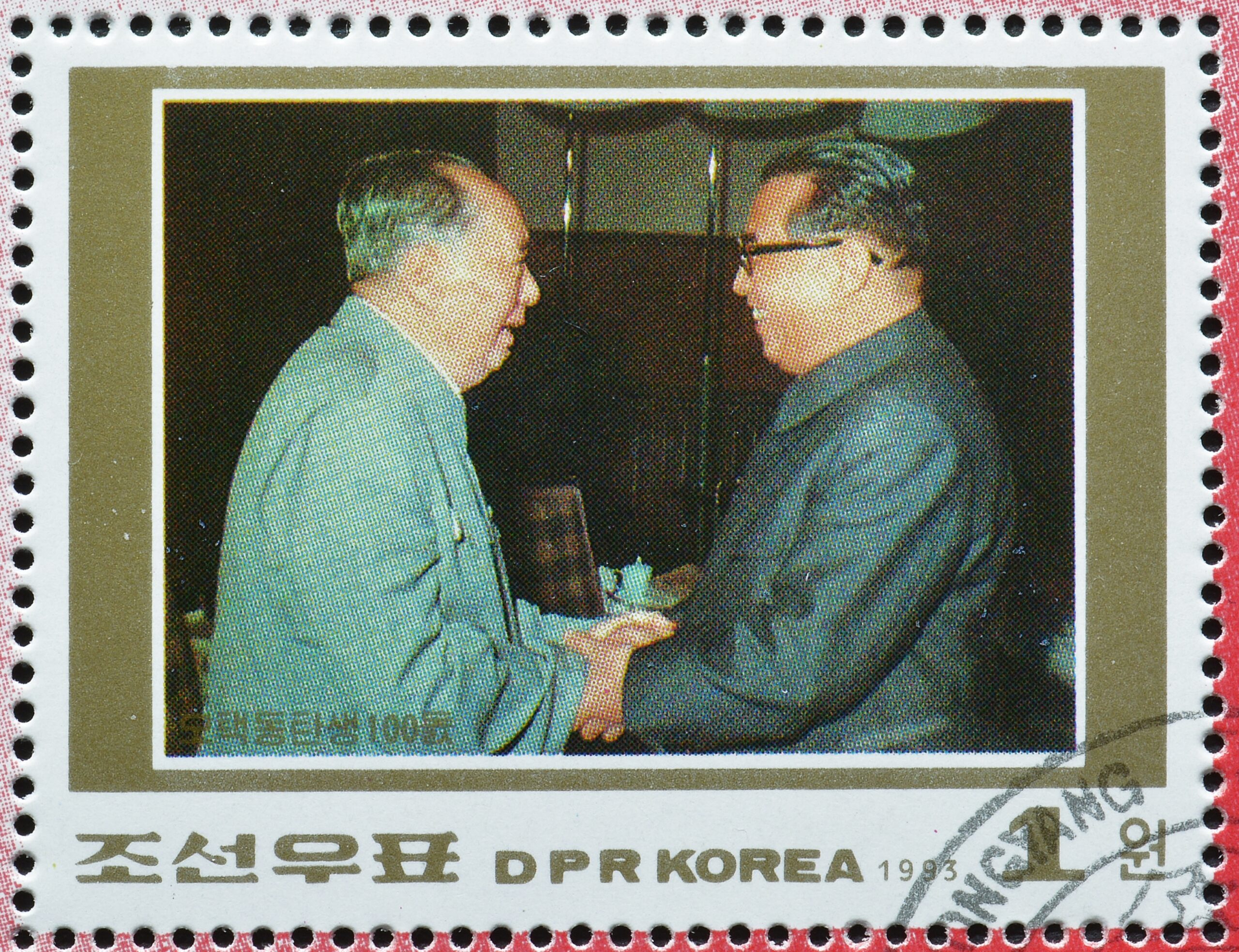
Succession and Secrecy: Intelligence on Mao Zedong and Kim Il-sung
Dr Nick Miller is a Professor of Intelligence Studies at the Citadel Military College of South Carolina
My doctoral research was shaped by my experience working within the US Department of Defense, where I managed portfolios related to China and North Korea. Across both cases, I encountered a persistent problem: the quality of intelligence collection was often poor, fragmented, and unreliable. This raised a fundamental question – had it always been this way?
When I posed this to colleagues across the US Intelligence Community, the answer was largely dismissive: these challenges dated back to the Cold War and were unlikely to change. I found that response unsatisfying. Rather than accepting it, I set out to understand how these intelligence failures developed and why they endured.
What emerged from my research was not a single cause, but a pattern of reinforcing decisions – early operational failures, shifting organisational priorities, and the erosion of regional expertise – that collectively produced long-term intelligence gaps. This pattern can be seen clearly in both the CIA’s experience with Maoist China and its approach to North Korea.
Maoist China and the CIA
The CIA’s difficulties in understanding China did not arise suddenly; they were the product of early missteps that shaped later priorities and capabilities.
Early Failure and Strategic Withdrawal
Between 1949 and 1952, the CIA launched two covert operations – HTMERLIN and BGMARQUE – both aimed at overthrowing Mao Zedong. Operating in isolation due to strict compartmentalisation, the two campaigns pursued different political outcomes but shared the same objective: regime change.
Both failed. More importantly, these failures had institutional consequences. Rather than prompting deeper investment in understanding China, they contributed to a strategic decision to divert resources elsewhere. By 1965, the CIA itself acknowledged that its ability to understand China was “continually handicapped.” The problem was no longer just operational – it had become structural.
Competing Priorities and Neglect
This early disengagement was reinforced by organisational priorities during the Cold War. Although concern about China resurfaced in 1966 – particularly in the context of the Vietnam War – the creation of a China Intelligence Working Group did not translate into meaningful resource allocation.
Requests to expand human intelligence collection were denied, as the Soviet Union remained the dominant focus. As a result, the CIA attempted to analyse China without the necessary inputs. By the late 1960s, its assessments were described internally as “fragmentary, incomplete, and irregular.” The earlier decision to deprioritise China had now translated into sustained analytical weakness.
Loss of Expertise and Analytical Limitations
Compounding these issues was a decline in China-specific expertise. The Red Scare led to the loss of many specialists, while others avoided the field due to career risks. This erosion of institutional knowledge had lasting effects.
By the mid-1970s, CIA training materials still placed little emphasis on Chinese history, political culture, or Maoist ideology. Instead, analysts were encouraged to interpret China through a Soviet lens. In effect, the CIA was trying to understand a distinct political system using an ill-fitting framework – further deepening its analytical limitations.
North Korea
A similar pattern emerges in the CIA’s experience with North Korea, though it began with a different kind of failure – one rooted in flawed intelligence collection rather than strategic neglect.
Catastrophic Human Intelligence Failures
During the Korean War, the CIA attempted to build a human intelligence network inside North Korea. These efforts were poorly designed from the outset. Inexperienced case officers, often with little regional knowledge, recruited untrained agents under extremely difficult conditions.
Initial reports suggested success, with claims of extensive penetration into North Korean institutions. However, these claims proved illusory. By 1952, it became clear that many agents had fabricated intelligence or were working for communist forces. For over a year, the CIA had been receiving systematically deceptive reporting.
This episode had profound consequences. It not only represented a major operational failure but also undermined confidence in the viability of human intelligence in North Korea.
Shift to Technical Collection – and Its Limits
In the aftermath, the CIA shifted toward technical intelligence methods, such as satellites and reconnaissance aircraft. While these tools provided valuable information, they could not fully replace human sources – particularly in a closed society like North Korea.
By the late 1960s, the limitations of this approach were clear. Internal assessments pointed to significant intelligence gaps and a “substantial deficit” in knowledge. Yet, as with China, organisational priorities prevented meaningful course correction. Resources remained elsewhere, and North Korea became a low-priority target unless a crisis emerged.
Dependence on External Intelligence
Without a reliable human intelligence capability, the CIA increasingly depended on South Korean intelligence. However, this introduced new challenges. US officials frequently questioned the reliability and objectivity of the information provided.
Moreover, South Korean intelligence agencies often prioritised domestic political concerns over gathering insight into the North. This misalignment further constrained the CIA’s ability to develop an accurate and independent understanding of North Korea.
Conclusion
Taken together, these cases illustrate a recurring dynamic. Initial intelligence failures did not lead to sustained institutional learning. Instead, they contributed to disengagement, misaligned priorities, and a gradual erosion of expertise.
Over time, these factors reinforced one another, producing the persistent intelligence gaps that analysts continue to confront today. What may appear as an enduring feature of difficult targets is, in fact, the outcome of specific historical decisions – decisions that shaped not only what the CIA knew, but what it could know.
The issues that impacted the CIA’s analysis on China and North Korea are numerous and each decision compounded the last. Thus, making attempts to change anything more difficult. These internal documents show that the CIA had lost its ability to effectively assess either country due to prolonged neglect, and that rebuilding this capability would require decades and a new generation of trained specialists. By carrying out this archival research I was able to illuminate lost parts of intelligence history and pieces of Cold War history that were previously hidden behind security classifications. While the resources were fragmented the CIA analysts for either department were working to build the best picture they could, given the resources they had available.
The opinions expressed are those of the contributor, not necessarily of the RSAA.
Watch Dr Miller’s lecture to the Society given in May 2026 –