Under the Eternal Blue Sky: Tengri, the Steppe and the Spiritual Vision of Kazakhstan
Aiganym Gali is a Kazakh-born painter
This article is adapted from the keynote speech delivered at the recent RSAA symposium, Kazakhstan at 35: A Symposium on a Transforming Nation.
There is a word that holds one of the oldest ideas of the Great Steppe: Tengri.
It is the ancient name for God among the peoples of Central Asia. It means the great blue sky. But within this simple word lies a profound understanding of existence: that the divine is both beyond everything and present within everything. That the world and the sacred are not separate. That we are not looking up at something distant. We are already inside it.
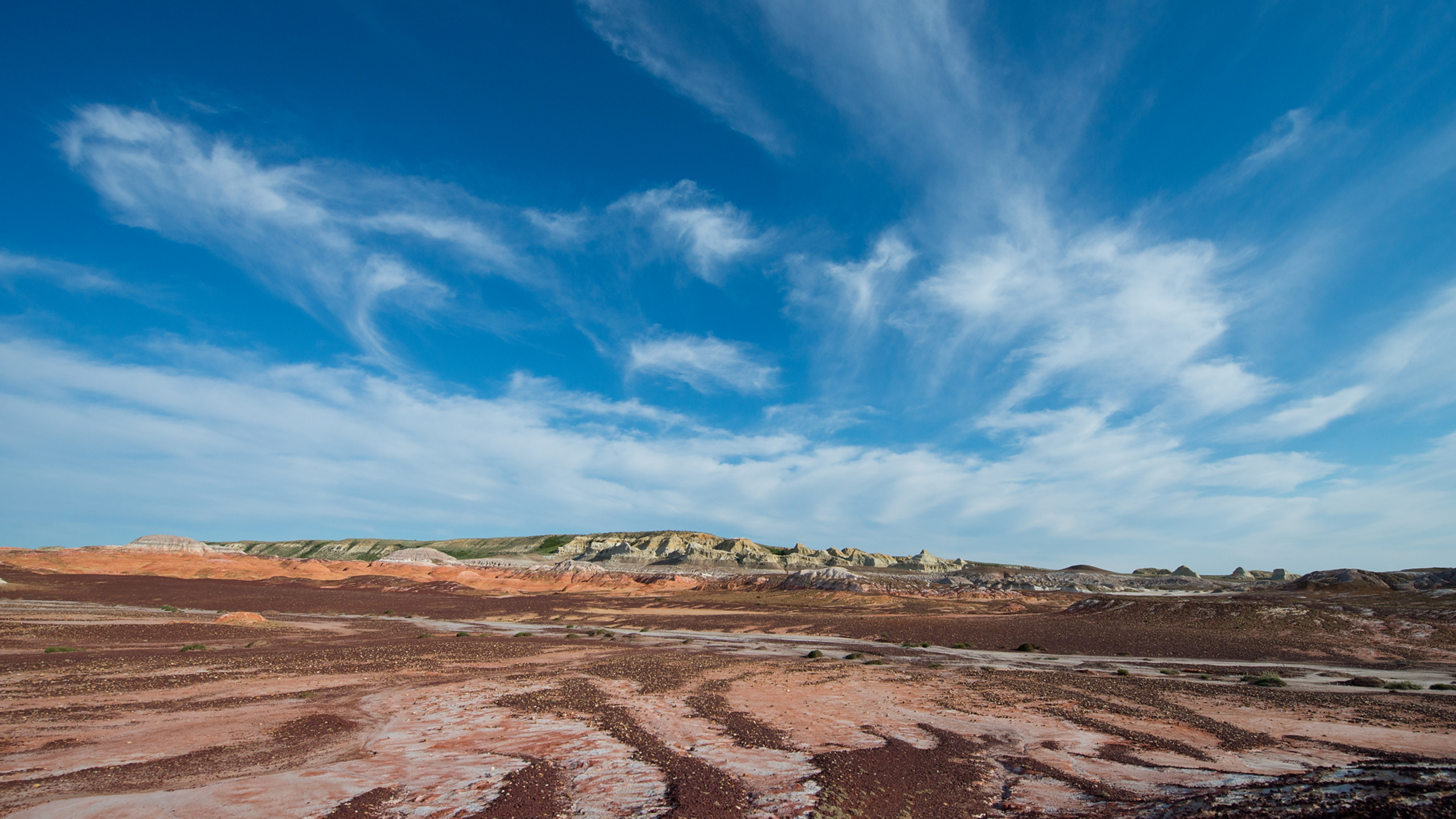
I grew up in Kazakhstan, between the Celestial Mountains of the Tian Shan and the vast expanses of the steppe. Yet it was not until 2007, when I travelled to western Kazakhstan to take part in a film, that I truly encountered my own land.
I stepped down from the film crew’s wagon and found myself standing in an immense landscape. For a moment, I could not move. The only movement was my blinking. And with every blink, the land seemed to change colour.
Silver. Green. Blue. Pink.
It was as though the sky were reflected on the face of the earth. A cloud moved, the air shifted, and the entire landscape transformed before my eyes.
I did not understand what I was experiencing then. Only much later did I begin to recognise it as an encounter with something much older than myself: Tengri.
Finding Tengri: The Spiritual World of the Steppe
Imagine a sea of grass stretching thousands of kilometres, from Hungary to Manchuria. This is the Great Steppe, the immense landscape that shaped the lives, cultures and spiritual imagination of the Turkic and Mongolian peoples.
For the nomads who lived there, the sky was not simply the space above them. It was the constant presence that accompanied them wherever they travelled.
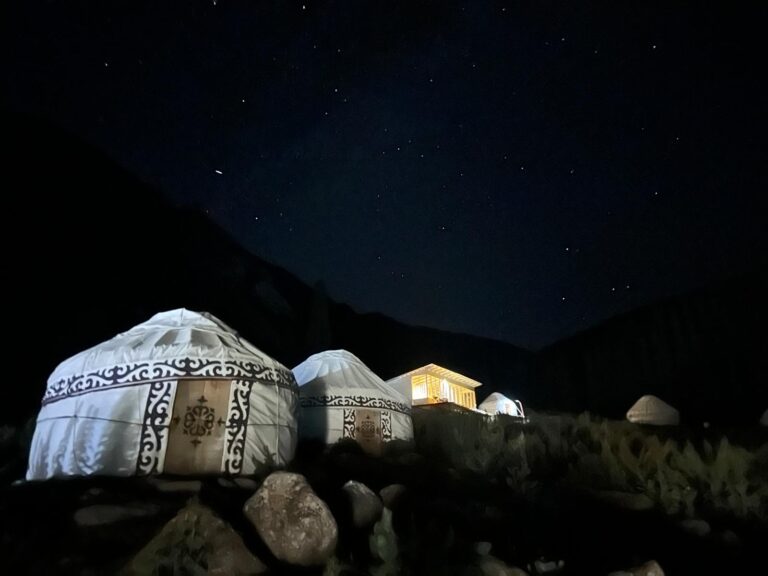
They moved with their herds and the seasons. They built no permanent temples, carried no monumental religious architecture, and needed no fixed place of worship. Their temple was the open horizon.
The name Tengri appears in ancient Chinese chronicles, while eighth-century Turkic inscriptions speak of the blue sky above, the dark earth below, and human beings created between them.
This was a worldview in which humanity occupied a place within a greater living reality.
The steppe was home to many successive cultures. More than five thousand years ago, people at Botai in northern Kazakhstan were already riding horses and milking them. Later came Bronze Age communities, whose imagery at Tamgaly included extraordinary figures with sun-like heads. Then came the Saka, known to the Greeks as Scythians, who left behind magnificent burial mounds and the extraordinary Golden Man discovered near Almaty in 1969.
These were not simply archaeological remains to me. They were fragments of a living inheritance.
As a child, I used to play on the green hills near my family’s country house, unaware that they were ancient burial mounds. Only much later did I understand that the history I was searching for in books had been beneath my feet all along.
Yet the most remarkable inheritance of the steppe was not its gold, its horses or its warriors. It was an idea.
God beyond everything, and within everything
Tengri offers a way of understanding the divine that is different from the familiar distinction between God and the world.
In one view, God exists outside creation, as its maker. In another, the divine and the material world are understood as one and the same.
Tengri suggests something more subtle: the divine is both transcendent and immanent. Beyond everything, yet present within everything.
The Kazakh scholar Zira Naurzbay expresses this idea in four words: “And God became the world.”
I was taught to understand this through colour.
Tengri is kök, blue: the sky, the breath, the soul. Umai is sary, yellow: Mother Earth, the body, the many shades of the soil. When blue and yellow meet, they create green: the colour of life.
These are not opposing forces, spirit against matter, or heaven against earth. They are different expressions of one reality.
At death, the body returns to Mother Earth and the breath to Father Tengri. Nothing is lost, because nothing was ever truly separate.
If everything exists within Tengri, then there is no absolute division between the sacred and the everyday, between humanity and nature, or even between ourselves and those we consider strangers.
The world is not something separate from the divine. It is the divine experiencing itself.
This understanding has echoes in other spiritual traditions, including Sufi mysticism and the Indian philosophy of non-duality. It also offers a different way of looking at the relationship between religions.
When Islam arrived on the steppe, it found a spiritual landscape already shaped by an intimate relationship with the divine. Through Sufi teachers such as Khoja Ahmed Yasawi, Islam found expression in the language, poetry and inner life of the nomads.
For many Kazakhs, Tengri, Kudai and Allah can coexist within the same spiritual vocabulary.
Not necessarily as competing ideas, but as different layers of an inherited understanding.
Forgetting the Name: A Century of Rupture
There is another part of this story, and it is much harder to tell.
The Kyrgyz writer Chingiz Aitmatov tells an old steppe legend about a man whose memory has been destroyed until he becomes a mankurt: a person who has forgotten his identity, his past and even his own mother.
In the story, his mother finds him and begs him to remember who he is. But he no longer recognises her. Following his master’s orders, he kills her.
As she falls, her white headscarf becomes a white bird that flies over the steppe, crying:
“Whose son are you? Remember your name!”
I have often thought about this story when reflecting on the history of Kazakhstan.
During the twentieth century, our relationship with our own cultural memory was violently disrupted.
Between 1930 and 1933, Soviet collectivisation forced nomadic communities to settle and deprived them of their herds. The famine that followed, known as Asharshylyk, killed between one and a half and two million people. Millions more were displaced, and the tragedy was suppressed for decades.
In 1937 and 1938, members of the Alash intellectual movement, who had sought to develop a modern Kazakh national identity and preserve our language and history, were executed as enemies of the people.
Our alphabet changed twice in eleven years. Our language and traditions were pushed aside. And between 1949 and 1989, more than 450 nuclear explosions took place at the Semipalatinsk test site, beneath the same great blue sky that had once been the centre of our spiritual world.
It was not only people who were lost. It was a relationship with the land, with memory and with an entire way of understanding existence.
I grew up in the Soviet period, when organised religion was pushed aside and replaced by an official ideology. My family came from different religious backgrounds: my mother’s side was Orthodox Christian, my father’s Muslim. My great-great-grandfather was a Sufi sheikh who was persecuted by the Soviet authorities and disappeared.
Like many families in our part of the world, we carried fragments of a history that could not always be spoken about.
And yet something remained.
Perhaps the deepest traditions are not always the ones we can consciously remember. Sometimes they survive as instincts, feelings and ways of seeing the world.
Sometimes we simply know something without knowing where that knowledge came from.
Finding It Again: The Artist as a Channel
My grandfather was an artist. After being exiled from the Caucasus to Kazakhstan, he worked as a graphic artist on geological expeditions, drawing the steppe.
I spent hours with him, watching and talking. I believe he passed something on to me.
When I was very young, I told my mother that I wanted to be an artist. She was horrified. She thought it would make my life difficult and leave me an outsider. But painting never felt like a choice. It felt like something inseparable from who I was.
Although I grew up without a clear understanding of Tengri, I always felt a connection with God. I was fascinated by spiritual stories and sacred texts, but never felt the need to belong to one particular religious institution.
Much later, when I began reading about Tengri, I experienced an extraordinary sense of recognition.
It was not so much discovering something new as finding the language for something I had always felt.
I am Tengri, and Tengri is me. I am the world, and the world is me.
I do not claim to live permanently in this state of awareness. But there are moments when the distance between myself and the world seems to disappear. It happens in nature, and it happens in my studio.
Learning to receive rather than invent
At art school, I was taught to approach painting intellectually, to construct an image through the mind.
But when I was sixteen, I met a remarkable Kazakh master who taught me something entirely different. He encouraged me to “plug in”, as he called it: to receive the work rather than invent it.
That lesson changed my relationship with painting.
After moving to London in 2007, I struggled with the distance from my homeland. I missed the openness of the landscape, the horizon, the light and the feeling of being connected to something vast.
Then, one night, I had a dream.
I walked into a large white space. On its walls were paintings of the moment I had experienced in the steppe: the changing light, the shifting colours, the extraordinary sense of movement.
I understood the dream as a challenge. I had seen it. Now I had to paint it.
For almost a year, I struggled to find the technique. Everything I produced felt too heavy. I could not translate the constantly changing light of the steppe onto a flat canvas.
And then something shifted.
I stood before one of my paintings and realised that the stage of self-expression had ended. I could no longer find myself in the work. It was as though the painting had come through me rather than from me.
I had become a channel.
I began working on enormous canvases laid out on the studio floor, kneeling for hours at a time. My studio became a place of almost monastic discipline. I prepared it carefully, removing distractions and practical concerns, entering the space with a clear mind.
Eventually, I began to understand why I was working on my knees.
The ego had to bow before I could stand as an instrument.
Today, I think of the studio as a sacred space. I try to enter it empty and leave empty. Whenever I attempt to add something clever or self-conscious, the painting seems to ask me to remove it.
People often ask where I find inspiration. But the word has never felt quite right to me.
If everything is Tengri, there is no outside from which inspiration must arrive.
My task is simply to remain clear enough to let something pass through me.
I sometimes describe myself as a postwoman. The message is not mine. My responsibility is to put it in the right envelope, attach a stamp and send it to the person for whom it was intended.
And that person may be anyone who stands in front of the painting.
When Tengri becomes geometry
Years later, another dream changed the direction of my work.
I dreamed that I was the colour orange. I was not looking at orange; I was orange, experiencing all its shades and tones, changing like fire, yet not fire.
There was no longer a separate self observing the colour. There was simply light.
A few days later, I prepared a canvas to paint the steppe, as I had done many times before. Suddenly, I felt an irresistible need to use a ruler. I had never used one in my painting and did not even own one.
I went out and bought it.
Back in the studio, I found the central line of the canvas and began working with symmetry and precise geometry. I understood intuitively that something new was emerging: Tengri was asking to be expressed through geometric form.
The result was the beginning of my series Tengri. Light Works, first exhibited in London in 2021. That same year, one of the paintings was selected for the Royal Academy Summer Exhibition.
What fascinated me was the response.
People would stand in front of these paintings and recognise connections with traditions I had not consciously set out to reference: the Vedas, Zoroastrian fire, Sufi symbolism, Islamic geometry and ancient sacred diagrams.
I had spent years reading about spiritual philosophies, but I had never systematically studied these visual symbols. In a sense, I was learning about them through my own paintings.
I was also comforted to discover that other artists had experienced something similar. The Swedish painter Hilma af Klint, working more than a century ago, described her paintings as coming directly through her, without preliminary drawings or a clear idea of what they would depict.
Perhaps there is a form of artistic creation that begins when the artist stops trying to control the outcome.
For me, painting has become a way of exploring the relationship between the visible and invisible, the material and immaterial, the individual and the whole.
It is also why I believe art is one of the strongest spiritual instruments humanity possesses. It can communicate something that words cannot always reach.
On the steppe, music was understood in much the same way. The traditional instrumental compositions known as kui were sometimes described as the whisper of Tengri. Poetry and improvisation were also ways of allowing something greater than the individual to speak.
Art is not simply an object we make. It can become a way of remembering.
The Eternal Blue Sky: A Living Inheritance
What does Tengri mean today?
It is not a church or an organised religion. Most Kazakhs today are Muslims, and Tengrism has relatively few formal followers.
But I do not believe Tengri lives in religious statistics.
I see it in the blue of our national flag, in the shaңyraq at the centre of our national emblem, in our traditional music and poetry, in the blessings of our grandmothers, and in the instinct not to cut down a solitary tree.
I see it in the curiosity of younger generations of Kazakhs, who are increasingly interested in rediscovering their cultural identity while remaining open to the wider world.
A generation is remembering its name, this time in its own language.
For me, this is not about returning to the past or rejecting the present. It is about recovering a way of seeing the world that can still offer something meaningful to humanity.
Tengri is not simply an ancient belief to be placed in a museum. It is an idea about our relationship with existence itself.
It reminds us that we are not separate from nature, that the sacred is not confined to buildings or institutions, and that the divine is not necessarily somewhere far away, waiting to be reached.
Perhaps the most important thing we can recover from the steppe is this sense of belonging to something immeasurably larger than ourselves.
I would like you to imagine, for a moment, standing in that landscape.
There is nothing between you and the horizon. No wall, no screen, no noise. Just the earth meeting the sky.
You feel very small, and at the same time, something within you becomes immense.
That feeling is where Tengri begins.
I live in Europe, travel constantly and try to own as little as possible. I belong to no particular group. In my soul, I feel like a snow leopard: not because I want to be alone, but because I want to remain free enough for something greater to come through me.
There is an old Kazakh expression:
Өлім жоқ, өмір жас!
There is no death; life is forever young.
Perhaps this is the ultimate message of the eternal blue sky: that nothing is truly separate, nothing exists entirely on its own, and life is part of a continuous whole.
So the next time you walk outside, take a moment to look up.
The sky you see is not simply above you.
You are inside it.
Silver. Green. Blue. Pink.
It all happens within Tengri.
The opinions expressed are those of the contributor, not necessarily of the RSAA.