The Tea House Answer: Why the UK Has an Embassy in Tajikistan
Hugh Stanley Philpott OBE is a former UK Ambassador to Tajikistan (2015–2019) and Turkmenistan (2019-2021) and author of The Singing Ambassador – A Tajik Story
“Tell me, Hugh, is it worth keeping these small embassies open? I mean, just how much impact can you have? And by the way, why am I going to be seeing a tea house?”
That was the question Sir Simon McDonald, now Lord McDonald of Salford, asked me as we sat outside Starbucks in Istanbul’s old Atatürk Airport in the autumn of 2018. At the time he was Permanent Under-Secretary at the Foreign and Commonwealth Office and Head of the Diplomatic Service. The FCO – later the FCDO – has always had one of the smallest budgets of the great Offices of State, yet one of the largest international footprints. It therefore lived under constant pressure to demonstrate value for money. One of Simon’s responsibilities was to decide where Britain’s diplomatic resources would have the greatest impact.
At the time I was HM Ambassador to Tajikistan. I was returning from business in Istanbul and Simon had just arrived from London. We were waiting for the overnight flight to Dushanbe, where he would spend just a day with me before continuing his tour of several of the UK’s smallest diplomatic missions in Central Asia.
His questions were perfectly reasonable. Like every ambassador, I believed my embassy mattered. The difficulty was that small embassies are expensive in relative terms. They require secure buildings, communications, well-trained staff and considerable logistical support.
I could have launched into an explanation of Afghanistan, the Great Game, organised crime and the strategic importance of Central Asia. But Simon already knew all that. He is a skilled historian as well as a diplomat.
Instead, I simply smiled.
“I hope,” I replied, “that Tajikistan itself will answer your question.”
When people discovered that I was the UK’s Ambassador to Tajikistan, their first question usually was, “Where exactly is that?” often followed by, “Why does Britain have an embassy there?”
It is a fair question.
If you are reading this, it is likely that you already know Tajikistan is a mountainous country of around ten million people, tucked between Afghanistan, China, Kyrgyzstan and Uzbekistan. From a British perspective, trade is modest, few tourists visit and it rarely dominates the headlines.
It hardly appears an obvious candidate for a resident British ambassador at a time when government budgets are stretched. Yet diplomacy has never been conducted solely on paper. Maps tell one story. Geography tells another. Look more closely and Tajikistan occupies one of the most strategically sensitive territories in Eurasia. It shares more than 1,300 kilometres of border with Afghanistan. It sits between the Russian, Chinese and Persianate worlds. It possesses the headwaters of Central Asia’s great rivers, on which millions of people downstream depend. It lies at the crossroads of political, economic and security interests that extend far beyond its own frontiers.
For the UK, understanding such a country is not optional. It is prudent. But geography alone does not justify an embassy. If maps were sufficient, British ambassadors could remain permanently in London. The real purpose of an embassy is not simply to observe events. It is to understand people. That is a slower altogether more involving process.
When I arrived in Dushanbe in 2015, I possessed the usual diplomatic briefing. I had all of the political background, economic data, security assessments and a reading list. It was comprehensive, professional and indispensable.
It also told me surprisingly little about the country in which I was about to become the British representative – or rather, surprisingly little in the voice of the Tajiks, since most of the literature available to me was Russian, European or American.
No briefing paper can explain why a village elder regards hospitality as a matter of honour. No political report captures what you learn by driving for hours through the Pamir Mountains or by listening to a young entrepreneur describe his hopes for his country’s future. Statistics do not tell you why Persian poetry is still quoted in everyday conversation or why a traditional melody can move an audience to silence.
Those things can only be learnt by living in a country, listening to its people and, over time, becoming a small part of its story. I tried to do that. Over time, I discovered that some of my most valuable diplomatic conversations took place nowhere near a ministry. They happened in schools and universities, in mountain villages and family homes, at concerts, over countless cups of green tea and occasionally while attempting to sing in Tajik. They rarely produced dramatic headlines. They did, however, produce something much more valuable.
They gave me understanding – and that understanding flowed in both directions.
People often assume that ambassadors exist to explain the United Kingdom to the countries in which they serve. Of course they do. But they also perform an equally important function in reverse when they explain those countries back to London.
When ministers in the FCDO ask for advice, they need more than facts. They need the context that gives those facts meaning. They need someone who speaks authoritatively, not only about what is happening, but why it is happening. That understanding is built gradually – meeting by meeting, conversation by conversation and relationship by relationship. The real challenge comes when you have only a hundred words in which to convey all of that. Knowing a country well allows you to be concise without losing meaning.
That cannot be created at the moment a crisis begins. It has to be there already. That is why embassies matter. Their greatest successes are often invisible. The commercial introduction that quietly leads to investment several years later. The trusted relationship that allows frank conversations during periods of political tension. The consular network that is already in place when a British citizen needs help. The years spent learning a country’s language, culture and history before they suddenly become relevant to decisions taken in Whitehall.
Diplomacy is an investment in local knowledge, and in things we did not know we needed to know, long before that knowledge becomes vital and urgent.
Towards the end of his programme, after meetings with Tajik government leaders, business figures, diplomats and the leaders of tomorrow, Simon and I visited the tea house that had prompted his question in Istanbul – and the raised eyebrow it had elicited in his office in London.
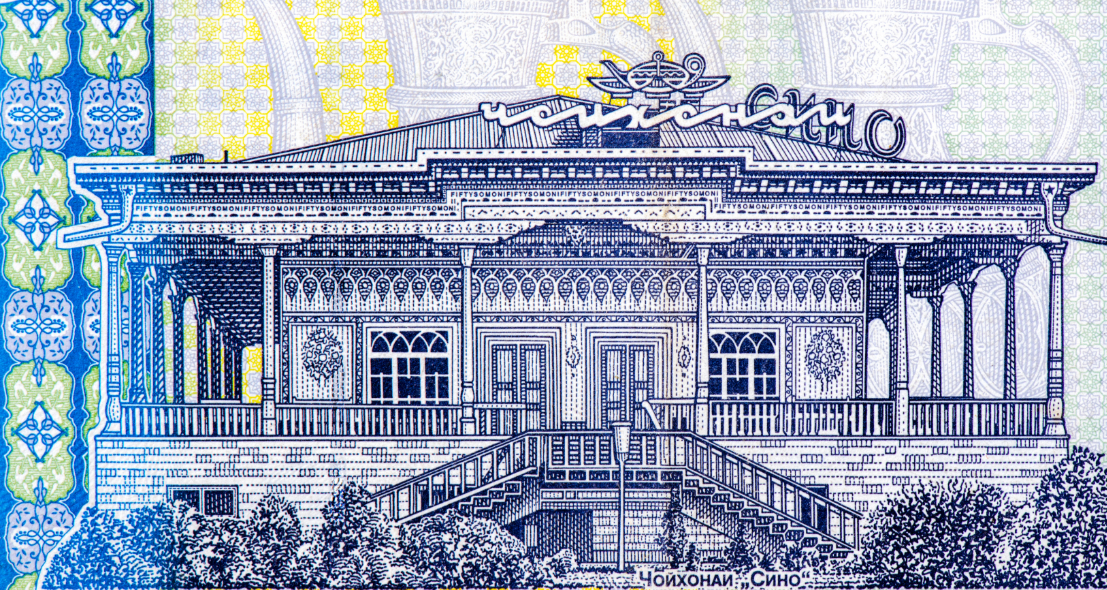
It was not just any tea house. It was Kokhi Navruz, the vast tea house and conference centre built for the 2014 Shanghai Cooperation Organisation summit. It is a palatial complex that hosts state banquets, international conferences and official receptions. So why had I chosen to bring the Head of the Diplomatic Service there?
Waiting to greet us at the entrance was Barno, the irrepressible Head Guide, whom I had come to regard as the chatelaine of Kokhi Navruz. She welcomed us warmly before whisking us from hall to hall with infectious enthusiasm. She was immensely proud of the building and of what it represented.
“Look, you,” she said, pointing to the carved ceilings and polished stone. “Our skilled Tajik masters made all these things. No foreigners. Look!”
She wasn’t simply showing us a remarkable building. She was explaining Tajikistan.
The chaikhana, or tea house, occupies a central place across the Persianate and Central Asian world. Whether in a remote village or a capital city, it is far more than somewhere for a quiet cup of tea and conversation. It is where hospitality is regarded as a duty rather than a courtesy; where differences are quietly explored; and where visitors begin to understand the rhythms of a society in a way that no briefing paper or official meeting can ever convey.
Kokhi Navruz tells an even deeper story. As Barno led us through its magnificent halls, Simon discovered that each room celebrated a different strand of Tajik craftsmanship and cultural heritage. One was adorned with intricate carved wood, another with polished stone from the Pamirs, another with dazzling mirror work reflecting a Persian artistic tradition stretching back centuries. Together they form not simply an impressive building but a journey through the civilisation that has shaped modern Tajikistan. As Simon wandered from hall to hall, he was no longer looking at a conference centre. He was reading a country’s history in wood, stone and glass.
It was not included as an interlude between the serious business. It was the serious business.
If Simon could understand why the Tajiks had built Kokhi Navruz in this way, he would begin to understand the country itself. Diplomacy is not simply about understanding governments. It is about understanding their history and culture, and the values of the people they represent. Before discussing security, trade or regional stability, it helps to understand the civilisation that has shaped the country. Kokhi Navruz expressed that more eloquently than any presentation I could have made.
As we left, Simon turned to me and smiled.
“I totally get the Tea House visit now. It’s stunning and says so much about the country.”
That single remark told me he had answered his own question. The visit had never been about architecture. It had been about understanding Tajikistan.
By the time we left, I hoped Simon had begun to appreciate that the value of a small embassy cannot be measured simply by the number of staff it employs or the volume of trade it supports. Its real value lies in helping Britain understand places like Tajikistan on their own terms. That process may begin in government offices, but it is completed in the places where people live their lives – in villages, schools, family homes and, occasionally, over a pot of green tea in a chaikhana.
As we continued around Dushanbe that day, meeting ministers, visiting projects and talking with embassy staff, I found myself wondering whether Simon’s question had already answered itself.
Not because I had argued Britain’s case for being there. But because Tajikistan had. Whenever people ask me today why the UK maintains an embassy in Tajikistan, I still think back to that conversation outside Starbucks.
It is easy to measure an embassy by the size of its budget, the number of its staff or the value of bilateral trade. Those are important measures. But they are not the whole story. The true value of a small embassy lies in something far harder to quantify. It lies in the understanding it gives Britain of a part of the world that matters more than its size or remoteness might at first suggest. Embassies are not only built for countries that are easy to understand. They exist because some places require patience, curiosity and a willingness to listen. That, in the end, is why the UK has an embassy in Tajikistan.
The opinions expressed are those of the contributor, not necessarily of the RSAA.

The Singing Ambassador: A Tajik Story
This rare insider’s view of contemporary Tajikistan blends memoir, travel writing, and cultural diplomacy to offer an intimate portrait of a country and people seldom seen through a Western lens. From dealing with his own health problems to negotiating the sensitive and volatile border with Afghanistan, from singing lessons with a world-renowned maestro to organising a major award in the name of a much-loved colleague, Philpott combines well-chosen stories of diplomacy, music and everyday life, filled with colourful characters, humour, challenge and pathos. His honesty and warmth shine through, as he welcomes the reader and takes them on a tour of a friendly, hospitable, beautiful and often-ignored country.