Shenzhen and China’s Technological Rise: The Role of Institutional Innovation

Dr Grace Yuehan Wang is A technology & innovation expert, a visiting fellow at the LSE and the author of Dragon Innovation
Kimi K3, developed by Chinese technology startup Moonshot AI, was officially released on 16 July 2026. As the largest AI model to emerge from China and one that many AI experts have described as a tipping point for the global AI industry, it has attracted attention from Western politicians who claim that Moonshot AI stole from Anthropic. Chinese technology companies are no strangers to such accusations. Back in 2018, Huawei, the world’s largest telecommunications manufacturer, became a focal point of the US-China trade tensions. How could a once little-known Chinese company become the world’s leading telecommunications manufacturer in an industry long dominated by the United States? “They must have stolen from us” has become a familiar response.
In recent years, the West, led by the United States, has increasingly viewed China’s technological rise through this lens. An article published by the RSAA argues that the West frequently misreads China, to the detriment of international dialogue and cooperation in trade, technology and institutional exchange.
In fact, such misreadings may ultimately do more harm to Western countries than to China itself. Drawing on my recent book, Dragon Innovation: Shenzhen, Lessons for the West and Global South Countries, I argue that understanding Shenzhen, China’s first Special Economic Zone, is essential to understanding China’s governance, development and technological innovation.
The significance of Shenzhen lies not simply in its economic success. More fundamentally, it represents institutional innovation and governance experimentation at a time when China was navigating geopolitical competition between the United States and the Soviet Union.
Era of Change
Chapter Two of my book, The Genesis of Shenzhen, examines both the domestic and international contexts surrounding the establishment of China’s first Special Economic Zone. Although China was politically aligned with the Soviet Union, the Soviet model’s lack of material prosperity, social progress and educational development in its later years increasingly undermined the idea that China should maintain a highly centralised, state-controlled economic system.
Deng Xiaoping, who would later return to power after the Cultural Revolution, addressed the United Nations General Assembly in 1974 as China’s representative. His speech positioned China as a Third World socialist country, emphasising the importance of resisting imperialist exploitation while pursuing political and economic independence. In January 1979, Deng visited the White House and met US President Jimmy Carter. A widely circulated photograph of Deng wearing a cowboy hat presented the Western world with a new image of China – one that appeared increasingly willing to engage with different social and cultural norms.
Institutional Innovation
Deng Xiaoping’s international visits, together with those of other senior Party leaders, laid the foundation for China’s Reform and Opening Up. In particular, Deng’s visit to Singapore demonstrated how a country with few natural resources had achieved economic development through foreign direct investment and the attraction of global talent. Upon his return, Deng prepared his famous speech for the Third Plenary Session of the Eleventh Central Committee (十一届三中全会) in December 1978: Emancipate the Mind, Seek Truth from Facts, Unite as One and Look to the Future (《解放思想,实事求是,团结一致向前看》).
For anyone seeking to understand China’s development trajectory, the ideas articulated in this historic speech remain essential today. Deng argued:
Local governments, enterprises and production teams should be given more autonomy in operation in provinces, cities, and autonomous regions. There are so many provinces, cities, and autonomous regions in our country. A medium province is equivalent to the size of a large country in Europe. It is necessary to have unified understanding, unified policies, unified plans, unified command, and unified actions while giving out more autonomy in economic planning, finance, and foreign trade management.
The establishment of Special Economic Zones in the early 1980s followed this principle of granting greater local economic autonomy while allowing some regions and people to become prosperous first. Concepts such as the “Mayor Economy” and local state capitalism can ultimately be traced back to this groundbreaking 1978 speech, which called for decentralisation in economic planning and management. Shenzhen emerged from this vision as China’s first Special Economic Zone – a national pilot programme for institutional governance and economic reform.
Local Governance – Bureaucratic Entrepreneurs
Special Economic Zones are not unique to China. However, in the Chinese context, the term carries a distinct patriotic significance, having evolved from “special zones” established for administrative and military purposes during the War of Resistance against Japanese Aggression.
An important question therefore arises: among China’s earliest Special Economic Zones – including Shenzhen, Shantou, Xiamen and Zhuhai – why did Shenzhen leapfrog the others to become one of the world’s leading innovation clusters within such a short period?
The answer lies in its local governance.
In Chapter Five of Dragon Innovation, Local Governance: Bureaucratic Entrepreneurs, I borrow the term “bureaucratic entrepreneurs” from UC Berkeley scholar You-tien Hsing, who used it to describe Guangdong government officials during the period when Taiwan’s garment industry established factories in southern China. The concept captures Shenzhen’s local officials particularly well.
As documented in my book, Deng Xiaoping gave unequivocal support to the Special Economic Zone experiments:
“The central government does not have any money. We can give you some [special] policies. You guys go do whatever you can do to kill a bloody road [to develop the country and boost the economy].”
In today’s startup world, entrepreneurs must secure funding, networks and resources despite having very little to begin with. Shenzhen’s bureaucrats adopted a remarkably similar approach. Acting as institutional entrepreneurs, they actively sought foreign direct investment, attracted investors, and recruited technical talent from both China and abroad.
Shenzhen–Inland Collaboration Model
Entrepreneurialism is deeply rooted in Shenzhen’s culture. From its earliest days, local bureaucrats embraced experimentation and risk-taking while remaining committed to the fundamental principle of China’s first Special Economic Zone: enterprise as the main body, government as the backing support (企业为主体,政府为后盾).
Local government officials were entrepreneurs, but more importantly, they were institutional innovators who pioneered China’s economic reforms. Without Shenzhen’s early experiments in institutional innovation and governance, there would be no widely replicated “mini Silicon Valleys” across China today.
In Chapter Five, Local Governance: Bureaucratic Entrepreneurs, I introduce the concept of the “Shenzhen–Inland Collaboration Model“ to describe how Shenzhen and inland cities leveraged their respective advantages to contribute to both the city’s development and China’s broader economic transformation.
During Shenzhen’s initial development phase, from 1979 to 1992, the municipal government promoted the “three supplies and one compensation” (三来一补) industrial model. Under this arrangement, factories in Shenzhen processed raw materials supplied by inland cities, assembled components based on designs provided by foreign enterprises, and exported the finished products. Rather than developing in isolation, Shenzhen’s manufacturing success was built upon close collaboration between inland regions, foreign investment and local government coordination.
A notable example of the Shenzhen–Inland Collaboration Model in science, technology and innovation was the relocation of research laboratories from Xi’an Jiaotong University to Shenzhen. At a time when Shenzhen lacked prestigious STEM universities, this partnership enabled scientific research to be commercialised while strengthening the city’s technological capabilities.
The Shenzhen–Inland Collaboration Model illustrates how Shenzhen’s bureaucrats pragmatically used the city’s institutional autonomy to identify development strategies suited to China’s broader reform agenda. In 1987, Shenzhen issued the first government document in Chinese history permitting the establishment of private enterprises. In 1993, it became the first Chinese city to abolish food coupons, symbolising the transition away from the planned economy. These landmark policy initiatives reinforced Shenzhen’s pioneering role as China’s “Entrepreneurs’ Paradise.”
Many of China’s best-known entrepreneurs were drawn to this environment. For example, BYD founder Wang Chuanfu relocated to Shenzhen after leaving his secure “Iron Rice Bowl” research position in Beijing, attracted by the opportunities created by the city’s institutional reforms.
Lessons for the West and Global South Countries
National pilot programmes, such as Special Economic Zones, are indispensable in countries with vast territories and complex systems of governance. Shenzhen continues to play this institutional role today. In 2021, it introduced the first personal bankruptcy regulations in mainland China. In 2022, the Shenzhen Special Economic Zone Artificial Intelligence Industry Promotion Regulations became China’s first legislation dedicated to promoting the AI industry. Despite continuing domestic and international debate over whether Shenzhen is truly “China’s Silicon Valley,” the city remains at the forefront of institutional innovation and technological development.
As I argue in Dragon Innovation:
Competition among existing and rising innovation hubs in China is an indication of its national strength, technological development and innovation capabilities overall. Healthy competition is an effective incentive which serves as the source of regional innovation and entrepreneurship. The rise of new innovation hubs in China does not diminish Shenzhen’s standing as a leading global innovation cluster, in the present and in the future.
Shenzhen’s experience also offers practical lessons for policymakers in both the West and the Global South, provided they are willing to assess China’s development on its institutional merits rather than through ideological assumptions.
Built upon the Shenzhen–Inland Collaboration Model, Shenzhen – the city that “became rich first” – has partnered with less developed regions to reduce regional disparities while supporting their economic and technological development. One example documented in my book is the “Special Economic Zone + Old Revolutionary Base Area Collaboration Model,” which extends the principles of the Shenzhen–Inland Collaboration Model and aligns with China’s Fifteenth Five-Year Plan for National Economic and Social Development.
During my research, an executive at a Shenzhen-based AI company explained that the firm’s assembly factory was being established in Jiangxi Province, only two hours away by high-speed rail. The proximity allows the company to combine Shenzhen’s strengths in innovation with Jiangxi’s need for economic development, illustrating how regional collaboration continues to underpin China’s industrial development.
This approach may also offer insights for the revitalisation of former industrial regions elsewhere. Could similar partnerships help revive declining industrial hubs in Europe? Might cooperation between advanced coastal regions and less developed inland areas contribute to manufacturing renewal in the United States? Although the US federal system differs fundamentally from China’s centralised political system, the broader question remains: what forms of intergovernmental cooperation could help address widening regional disparities?
As discussed in my book, Shenzhen also challenges the stereotype of Chinese bureaucrats as passive or rigid administrators. Instead, many local officials demonstrate a culture of continuous learning and competition. In Chapter Eleven, Research Note: Emerging Sensitive Research, I describe conversations with Shenzhen officials who had undertaken executive training programmes in the United States on topics including artificial intelligence and public–private partnerships.
Such international exposure strengthens local officials’ institutional capacity by broadening their understanding of technological development and governance. It also enables them to make more informed assessments when evaluating local enterprises and startups for public support. Several officials responsible for science, innovation and talent attraction also described how meeting directly with scientists and entrepreneurs overseas helped them design more effective talent policies – not only addressing researchers’ professional concerns but also considering the practical needs of their partners and families when they relocate to Shenzhen.
Era of Change, Again
In early 2026, while discussing the subtitle of my book with several friends, some expressed reservations about the phrase Lessons for the West, while others supported it without hesitation. Their reactions reflected a broader question: can the West learn from China in areas such as institutional innovation and technological development when China’s development continues to be widely misunderstood?
As I have argued throughout this article and explore in greater detail in Dragon Innovation, China’s Reform and Opening Up emerged from a period in which the country was searching for its own path to economic development. Although politically aligned with the Soviet Union, China ultimately chose a different institutional trajectory while navigating geopolitical competition between two superpowers.
Today, we may once again be entering an era of profound geopolitical and technological change. As competition over artificial intelligence, advanced manufacturing and technological leadership intensifies, understanding how institutions shape innovation has become more important than ever. Shenzhen’s experience suggests that technological leadership is not simply the product of scientific breakthroughs or entrepreneurial talent, but also of institutional experimentation, adaptive governance and the willingness to learn from experience.
Whether other countries ultimately choose to learn from China’s experience remains an open question. However, dismissing China’s development through political or ideological assumptions risks overlooking institutional lessons that may prove increasingly relevant in another era of global transformation.
The opinions expressed are those of the contributor, not necessarily of the RSAA.
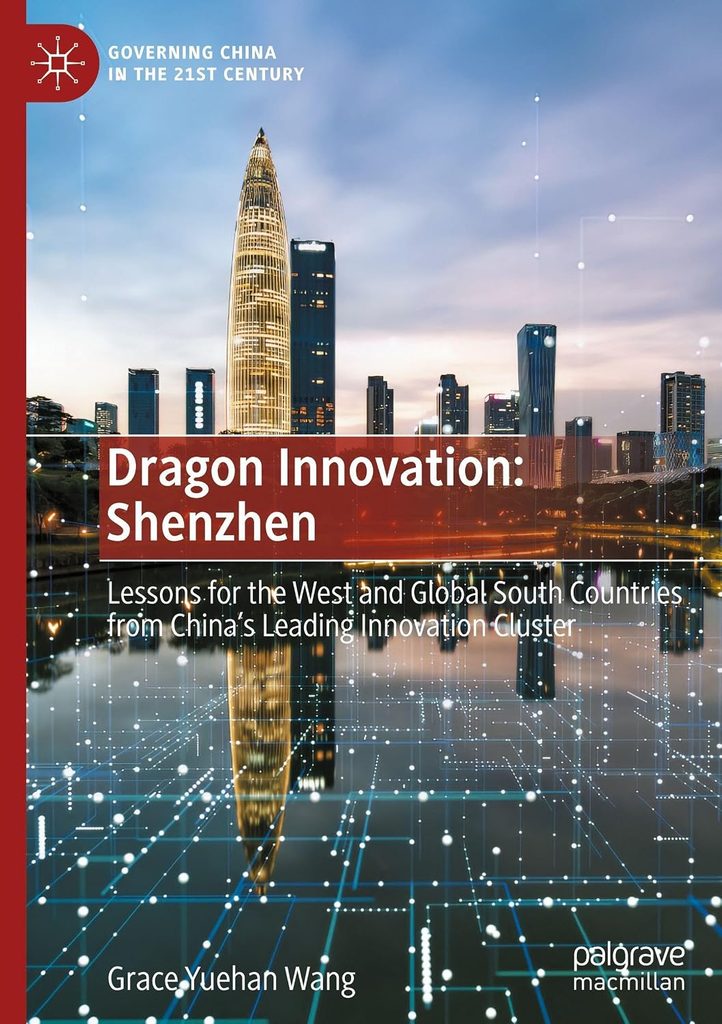
Dragon Innovation: Shenzhen – Lessons for the West and Global South Countries from China’s Leading Innovation Cluster
Dragon Innovation explores how Shenzhen and the Greater Bay Area became one of Asia’s leading technology and innovation clusters. Against the backdrop of China’s extraordinary economic and technological transformation, global trade tensions, and great-power competition, the book examines Shenzhen’s rise through historical, political, cultural, institutional, business, and social perspectives. Drawing on first-hand interviews with leading figures from Huawei, Tencent, BYD, government, technology and AI companies, as well as investors, academics, entrepreneurs, and migrant professionals, it offers a vivid and original account of an innovation ecosystem that differs fundamentally from its Western counterparts.