Kyrgyzstan: Central Asia’s Shrinking Space for Media Freedom
This piece was written by an anonymous contributor
The Story of How Kyrgyzstan’s Democratic Oasis Dried Up
Over the past six years, Kyrgyzstan’s media landscape has sharply deteriorated. Independent outlets have been shuttered, investigative journalists increasingly labelled extremists, and critics silenced. Human rights groups warn that the country – once seen as Central Asia’s “democratic oasis” – is entering its most repressive period since independence.
When Kyrgyzstan broke away from the Soviet Union in 1991, it seemed determined to leave behind the country’s painful legacy of political repression, which had affected around 40,000 people during the Soviet era. Despite chronic corruption and recurring political turmoil, the country has long stood out in the region for its competitive politics, outspoken public debate, and relatively free press.
Pressure on independent journalism had been mounting for years, but accelerated after President Sadyr Japarov came to power in 2020. Since then, media experts say, Kyrgyzstan has experienced the harshest crackdown on independent journalism in its post-Soviet history.
The shift is reflected in international rankings. Between 2020 and 2026, Kyrgyzstan fell from 82nd to 146th place in the World Press Freedom Index compiled by Reporters Without Borders, one of the sharpest declines recorded anywhere in the world.
The Rise and Rollback of Independent Media
Independent journalism flourished in Kyrgyzstan after reliable internet access spread in the late 2000s. Dozens of online outlets emerged, openly challenging political elites and creating something rare in Central Asia: a media environment in which officials could be criticised publicly and investigative reporting could shape political life.
Ironically, Sadyr Japarov once benefited from that openness. During years in political exile and imprisonment, independent media gave him a platform to address the public and helped shape his image as a victim of political persecution.
Once in power, however, the relationship changed dramatically. Together with his ally Kamchybek Tashiev, head of the State Committee for National Security, Japarov oversaw a sweeping campaign against independent media. Raids, arrests, criminal investigations, website blocking, and intimidation soon became routine.
At the same time, the legal foundations for tighter control expanded rapidly. In 2021, Kyrgyzstan adopted a new constitution that Human Rights Watch said conflicted with international human rights standards. Months later, Japarov signed a broadly worded law on “false” and “inaccurate” information, giving authorities the power to block websites without a court order.
The pressure intensified further. In 2024, parliament passed a “foreign representatives” law widely criticised as a copy of Russia’s notorious “foreign agents” legislation – a tool long used to pressure journalists, NGOs, and civil society organisations.
By 2025, Kyrgyzstan had effectively reversed years of media liberalisation. Amendments to the Code of Offences reintroduced penalties for defamation and insult, allowing police and courts to punish media outlets and individuals for allegedly spreading “false information” online through expedited procedures with limited judicial oversight.
Soon after, lawmakers aligned with the Japarov-Tashiev leadership approved a restrictive media law requiring all media outlets and online platforms to register with the state, tightening licensing controls and capping foreign ownership at 35 percent. Human Rights Watch warned that the law could be used to deny registration to independent outlets and silence critical voices without judicial oversight.
In July, new amendments to the Criminal Code and the Code of Offences further tightened penalties linked to so-called “extremist activity.” The changes strengthened punishment for distributing extremist materials and for the violent seizure of power, while also restoring criminal liability for possessing extremist content – a provision previously removed because of its repeated misuse against individuals with no connection to violent crimes.
The Criminalisation of Journalism
Despite President Sadyr Japarov’s repeated promises to protect civil liberties, investigative journalism in Kyrgyzstan has increasingly been treated as a security threat rather than a public service.
After consolidating power in 2021, Japarov pushed through constitutional changes that weakened institutional checks and strengthened presidential authority. Pro-government parties later dominated parliamentary elections, while pressure on independent media intensified through outlet closures, criminal cases, newsroom raids, and intimidation.
One early target was Taalaibek Duishenbiev, head of opposition broadcaster Next TV. In 2022, he was convicted of inciting inter-ethnic hatred after reporting claims that Kyrgyzstan’s military may have provided assistance to Russia during the invasion of Ukraine. His five-year prison sentence was later reduced to probation.
Pressure also mounted on Temirov LIVE, known for investigations into high-level corruption. Shortly after publishing a report on business interests linked to security chief Kamchybek Tashiev’s family, founder Bolot Temirov was arrested on drug possession charges that he and his colleagues said had been fabricated. Although acquitted, he was deported to Russia in 2022.
By 2024, the crackdown had escalated into mass prosecutions. In January, authorities arrested eleven journalists linked to Temirov LIVE after raiding their homes and confiscating equipment from the outlet’s office. Two detainees – Makhabat Tajibek Kyzy and poet Azamat Ishenbekov – received prison sentences of six and five years respectively on charges of “inciting mass unrest” through their journalistic work. Two colleagues were handed three-year probation terms.
Although Azamat Ishenbekov was released from prison after receiving a pardon in April 2025, Makhabat Tajibek Kyzy was freed from custody pending a retrial in March 2026 but remains barred from leaving the country and the charges against her remain in place.
In March 2025, journalist and activist Kanyshay Mamyrkulova was detained over Facebook posts criticising the opaque negotiations surrounding the Kyrgyz-Tajik border agreement. Four months later, she was convicted of inciting mass unrest, receiving a four-year suspended sentence and a ban on publishing content on social media.
The authorities also moved directly against independent broadcasters. In July 2025, a court in Bishkek ordered the liquidation of April TV, with officials making little attempt to conceal that the channel was being punished for its critical reporting.
Pressure likewise intensified on Kloop.kg, one of Kyrgyzstan’s best-known investigative outlets. In May 2025, security forces detained eight staff members during coordinated raids, froze bank accounts, and later secured convictions against journalists accused of “calling for mass unrest.”
In September, four Kloop.kg journalists were convicted on the same charge. Two videographers received five-year prison sentences, while two accountants were sentenced to restricted freedom for three years. Prosecutors alleged that the outlet had collaborated with Temirov LIVE to spread “distorted information” intended to provoke regime change.
The crackdown reached a new level in October 2025, when a Bishkek court designated Temirov LIVE, Kloop.kg, and “Ayt Ayt Dese” as “extremist organisations.” The ruling followed investigations alleging that major state contracts had been awarded to companies linked to figures close to President Japarov.
The court declared not only the outlets’ materials extremist, but also the activities of their founders – effectively criminalising affiliated platforms and investigative journalism itself. Yet these were only the most high-profile episodes in a much broader campaign against independent voices. For many within the media community, the message was unmistakable: in today’s Kyrgyzstan, investigative reporting has become synonymous with extremism.
The Language of Stability, the Reality of Repression
Officials argue that these measures are necessary to combat disinformation, foreign interference, and social unrest. Journalists and human rights groups see a different objective: silencing criticism, intimidating independent media, and shutting down investigations before they become politically dangerous. Critics increasingly warn that Kyrgyzstan is moving toward a Russian-style model of media control, in which restrictive laws, security services, and courts work together to suppress dissent.
President Sadyr Japarov rejects claims that his government is curbing free speech. In a January 2026 interview with the state agency Kabar, he insisted that Kyrgyz citizens enjoy as much freedom of expression as ever – but added a familiar caveat: freedom must come with “responsibility.” Authorities, he said, target not critics but those accused of spreading lies, destabilising society, or threatening the constitutional order under the banner of free speech.
In practice, however, vague accusations of extremism, destabilisation, and hostility to the state are increasingly defining the boundaries of acceptable speech. The language may be new, and the scale far removed from the terror of the Soviet era, but for many journalists and activists, the atmosphere feels alarmingly familiar.
More than three decades after independence, the country once seen as Central Asia’s democratic exception is becoming steadily less open. Fear, self-censorship, and political loyalty are replacing the freedoms that long set Kyrgyzstan apart. With every newsroom raid, extremism case, and silenced critic, the gap between the country’s post-Soviet aspirations and the authoritarian past it sought to escape narrows further.
As Kyrgyzstan deepens its engagement with European capitals in pursuit of investment, trade, and political legitimacy, an uncomfortable contradiction is becoming increasingly difficult to ignore. In London, Brussels, Berlin, and Paris, officials invoke the language of partnership and shared interests. Yet if commitments to democratic standards and media freedom are to amount to more than diplomatic rhetoric, an awkward question presents itself: how far can cooperation deepen as the space for independent journalism continues to contract?
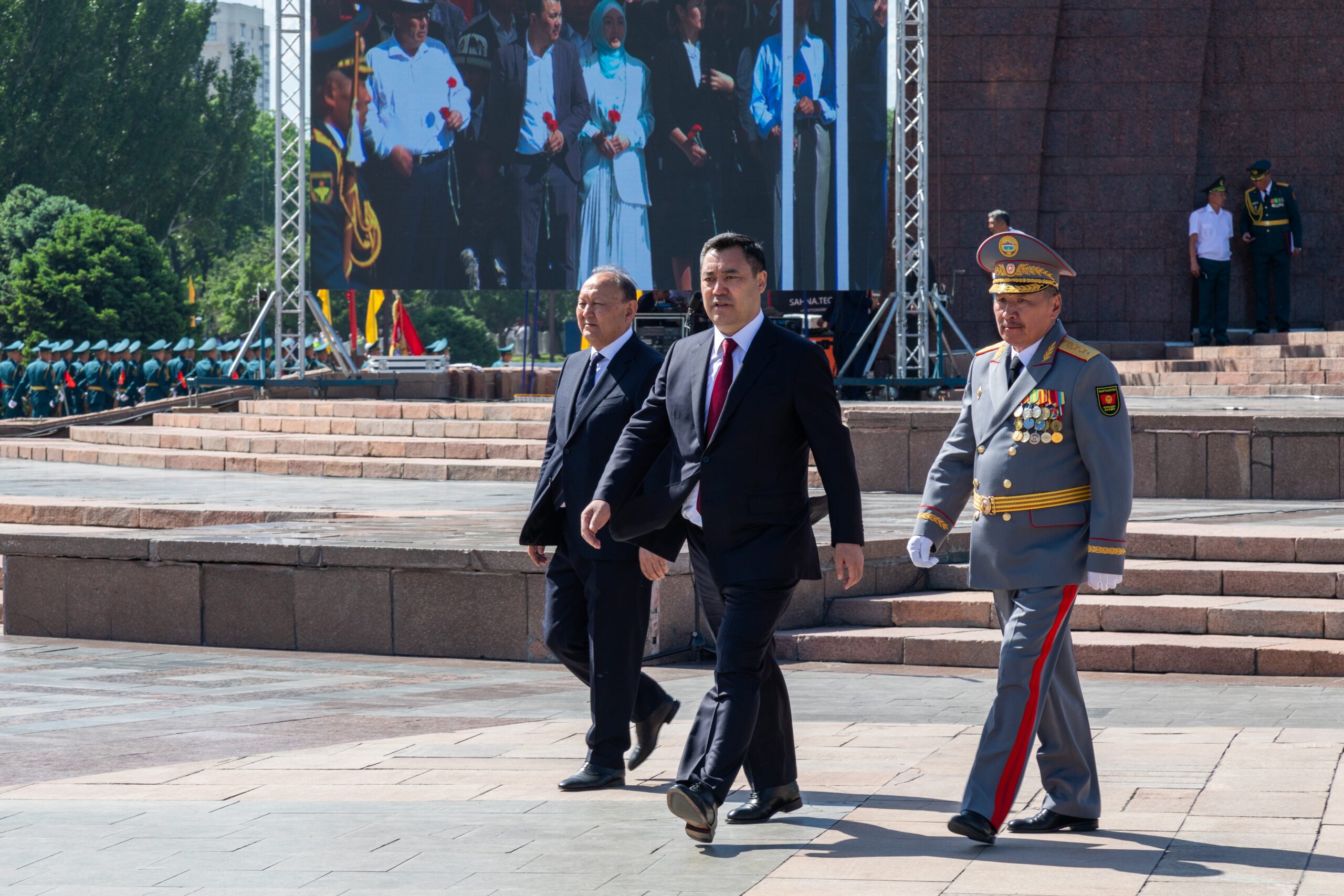
*the image shows President Sadyr Japarov at an event in Bishkek, 2022.
The opinions expressed are those of the contributor, not necessarily of the RSAA.