Rock Art and its Legacy in Myth and Art
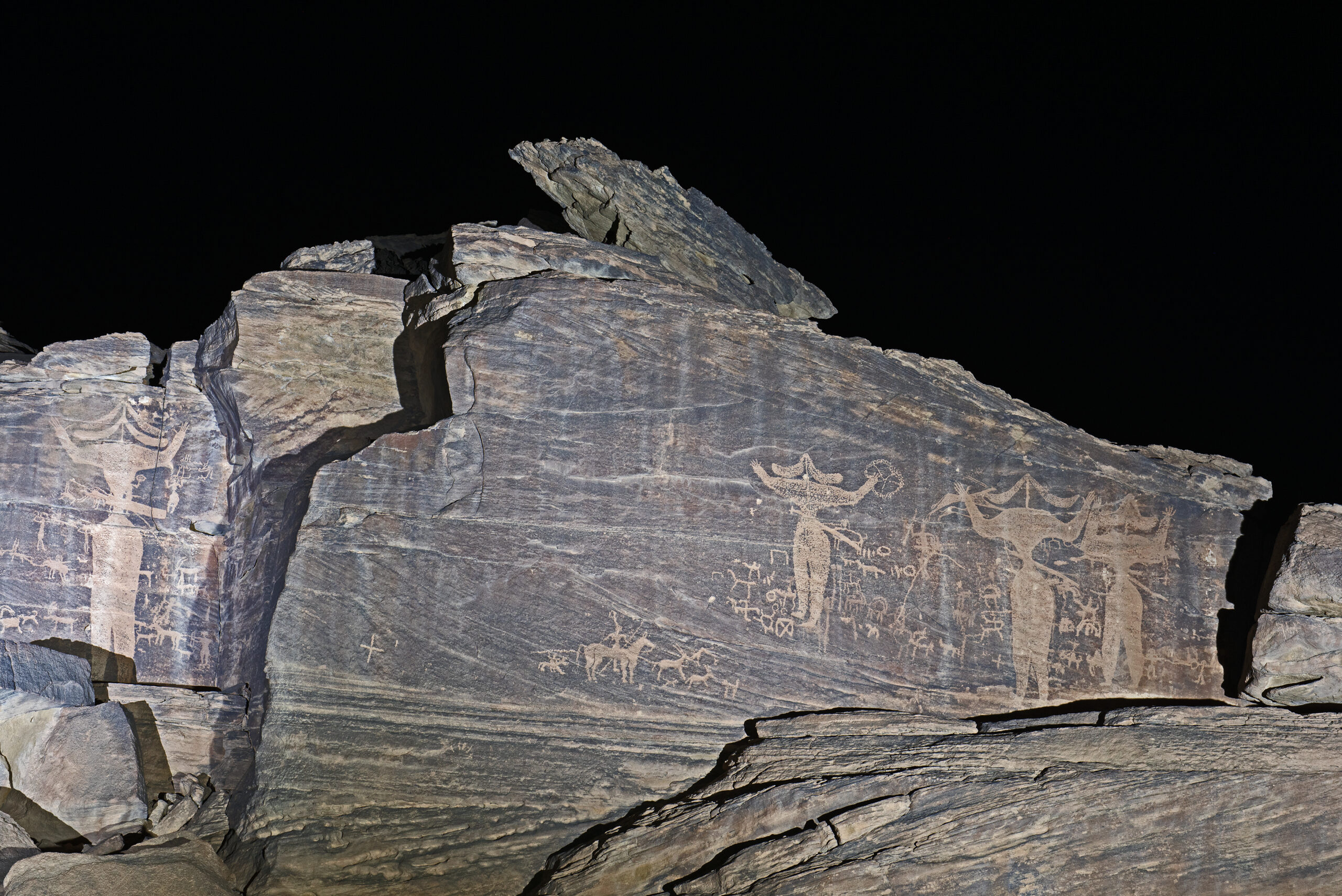
Image – larger than life petroglyphs of armed men from the late pre-Islamic period at Al-Khayyur, Asir, Saudi Arabia.
Christoph Baumer and Therese Weber, 1 October 2026 18:30 BST Hosted by the Royal Asiatic Society
No registration is required to attend in person. Simply attend the Royal Asiatic Society, 14 Stephenson Way, London NW1 2HD, on the date and at the time specified above.
Petroglyphs are, since the Upper Palaeolithic, one of the oldest types of human visual expression. They not only reflect societal and economic adaptations to climate and environmental changes but also encapsulate the worldviews, myths and rituals that were prevalent at the time. As the climate changed dramatically from the Last Glacial Maximum to the Holocene Climatic Optimum, and again to renewed climatic cooling and gradual desiccation, fauna, flora and humans had to adapt. These changes are recorded in petroglyphs. Regarding pre-literate societies, they represent, together with archaeology, one of the most informative sources for gaining insights into bygone cultures. The makers of petroglyphs were masters of abstraction, using the simplest of tools to capture the essence of a wide variety of animals, humans and objects, and to depict complex scenes. In this sense, petroglyphs are pieces of ancient art. In spite of their great antiquity, petroglyphs have regained topicality in recent decades as contemporary artists find in them inspiration and a means to gain access to their own cultural heritage.
The illustrated lecture is related to Christoph Baumer’s and Therese Weber’s recent book Rock Art and its Legacy in Myth and Art (Bloomsbury), which is the result of thirty years of petroglyph research in Central Asia, Scandinavia, Arabia and the Sahara.
Christoph Baumer is the founder of the Society for the Exploration of EurAsia, as well as an historian and explorer of ancient cultures and petroglyphs of Central Asia, the Caucasus and Arabia. His main publications include The History of Central Asia in 4 volumes (2012–2018) and The History of the Caucasus in 2 volumes (2021/2024).

Therese Weber is Professor Emeritus at the University of Applied Sciences Northwestern Switzerland. An artist and researcher, she is a key protagonist of Paper Art. She weaves paintings, photography and performative actions into an innovative visual means of expression. Her publication, The Language of Paper (2007), became a standard reference work.