Escaping the Great Game
Joe Luc Barnes is a British writer and journalist based in Kazakhstan
When English-speaking visitors are introduced to Uzbekistan, the story of Charles Stoddart and Arthur Conolly is never slow to raise its head. The fate of these two British officers, executed in the town square of Bukhara in 1842, has long served as shorthand for a particular vision of Central Asia: cruel, closed, and ruled by capricious despots.
In Victorian Britain, their deaths were absorbed into the meta-narrative of the so-called Great Game, which saw Central Asia as a wild, remote stage for the imperial rivalry between London and St Petersburg. In Russia, and later the Soviet Union, the same episode helped justify the conquest of the region by presenting it as backward and barbaric.
Even today, the Stoddart-Conolly affair continues to be mythologised. Read any guidebook on Uzbekistan and the well-worn yarn will make an appearance.
But perhaps the persistence of this story, now almost two centuries old, tells us more about those who have repeated it than it does about Bukhara itself. While the Great Game may be over, the habits of thought it produced remain surprisingly hard to dislodge.
The story
In 1838, Colonel Stoddart arrived in the Emirate of Bukhara, one of three khanates located in what is now Uzbekistan. A Bengal Army officer serving under the East India Company, he claimed to be on a mission from the recently crowned Queen Victoria. His task was to establish friendly relations with Bukhara’s ruling Emir, and to discourage him from aligning with Russia.
Then, as now, Britain and Russia regarded one another with deep suspicion. In London, and even more so in Calcutta, where the East India Company was based, there was anxiety that St Petersburg, emboldened by its victory over Napoleon and its advances in the Caucasus, might push southwards – uncomfortably close to the Indian subcontinent.
Such was Britain’s anxiety that, later that year, it invaded Afghanistan in an attempt to install a friendly ruler and create a buffer state guarding the approaches to India.
As part of the diplomatic manoeuvring that preceded the campaign, Stoddart was dispatched to Bukhara by the Government of India under Governor-General Lord Auckland to reassure Emir Nasrullah that Britain presented no threat to his realm, and to propose a treaty of friendship. An additional aim was to persuade the Emir to release any Russian captives who were living in Bukhara as slaves, thereby removing a potential pretext for Russian intervention.
Things went wrong almost immediately.
“He violated a lot of protocols,” says Dr Vahid Kholov of the Institute of History at the Academy of Sciences of Uzbekistan. The letter he carried, though written in the name of Queen Victoria, had been arranged by the Government of India rather than personally signed by the Queen, and he lacked credentials equivalent to those of a sovereign envoy. “In diplomacy, if the letter is written to a certain person, it should be sent from a person of equivalent rank,” Kholov explains. “This also caused some doubts.”
Stoddart, it seems, was also rather too cocksure. Later sources assert that when he entered the city, he refused to dismount from his horse, despite being told that only Muslims were permitted to ride within the walls.
“He seems to have had a knack for rubbing people up the wrong way,” says Professor Alexander Morrison of New College, Oxford. “He definitely treated Nasrullah with what the Emir perceived as disrespect.” (Professor Morrison gave a lecture to the RSAA in 2020 entitled The Russian Conquest of Central Asia and the Myth of the “Great Game”)
Nasrullah was not a man to be slighted. He had seized the throne in 1827 after a violent succession struggle following the death of his father, eliminating rival brothers to secure his rule, and ruled as a stern, often ruthless autocrat. Known to his contemporaries as Bahadur Khan (the brave ruler), his aggression was largely directed towards the rival Khanate of Kokand, which he invaded repeatedly in an attempt to reclaim the Ferghana Valley.
Kholov notes that Nasrullah lacked the religious authority of his father, who was known as a pious man, and governed harshly in order to hold the fragmented emirate together. “He had to take some strict measures. It was the necessity of the time,” he says.
This was the character that Stoddart had chosen to offend. Nevertheless, the Emir appears initially to have been cautious about provoking Britain, which in 1838–39 was advancing into Afghanistan and installing a friendly ruler, and whose power in the region seemed to be growing. Rather than execute Stoddart outright, Nasrullah had him detained while he weighed his options. His detention would last more than three years, and Stoddart’s conditions fluctuated with the geopolitical winds: at times he was confined in the city jail, or Zindan, a prison notorious for vermin and filth; at others he was allowed limited freedom within the city.
In 1841, another British officer appeared in Bukhara, attempting to secure Stoddart’s release. But Arthur Conolly had not timed his arrival well. In the intervening three years, Afghanistan had risen up in revolt, and Britain’s position in the region had collapsed. The retreat from Kabul in 1842 was a catastrophe, and the aura of British power had evaporated.
“The execution was a hard-power decision,” Morrison argues. “Nasrullah concluded that the British were now irrelevant. He didn’t need to bother with them anymore.”
But Nasrullah’s conclusion proved incorrect. In death, Stoddart and Conolly’s story took on a life of its own.
The Soviet retelling
Kholov, who grew up in the Soviet Union, recalls how the Soviets used the story and Nasrullah’s character for their own ends. “When I studied at school, in our textbooks Nasrullah was written as a butcher,” he says. “That’s how he’s seen in Soviet historiography – he has a very bloody reputation.”
In fact, the Soviets did not invent this negative image from scratch. They drew on the earlier work of the Jadids, reformist Muslim intellectuals in late imperial Central Asia, who had already depicted Bukhara’s emirs as reactionary rulers holding their people back.
By adopting and amplifying these critiques, Soviet historians could present figures like Nasrullah not simply as cruel individuals, but as symbols of a backward order that Russian – and later Soviet – rule had supposedly swept away.
This was important, because without this, the Russian conquest of Central Asia posed an ideological problem for Soviet historians.
“It is so obviously a case of fairly unprovoked aggression with obvious parallels between Russia and other colonial powers,” says Morrison. Therefore, from the mid-1930s onwards, a narrative was put forward in which the Russians brought a superior civilisation to the region.
“In this version,” Morrison explains, “Russia displaces a bloody system of feudalism, of which Nasrullah is an exemplar.”
The British retelling
While the story did become a minor cause célèbre in the British press, with politicians using it to attack the Whig government of Lord Melbourne for its perceived inaction in securing Stoddart’s release, events elsewhere soon dwarfed the affair. The uprising in Kabul in 1841 and the disastrous retreat of British forces from Afghanistan in 1842, in which an entire army was effectively annihilated, consumed public attention. Compared with that catastrophe, the fate of two imprisoned officers in Bukhara seemed a grim but secondary drama.
Yet after their execution, Stoddart and Conolly were recast as Great Game martyrs that loomed larger in retrospect than they did in their own time.
Writers have been central to this transformation. From Kipling’s Kim in 1901 to John Buchan’s thrillers a decade later, and Fitzroy Maclean’s post-war accounts, these authors transformed Central Asia into a romantic frontier where warrior-scholars entered a battle of wits with their Russian counterparts, each trying to coax the region’s temperamental rulers into their camp.
Modern readers are most likely to be familiar with Peter Hopkirk’s The Great Game, published in 1990 but still selling well today. Hopkirk’s version opens with the Stoddart and Conolly tale on page one.
He lingers on the so-called “bug pit” in which Stoddart and Conolly were imprisoned, describing rats and vermin in a specially constructed cell beneath the citadel. “For months they had been kept in a dark, stinking pit,” Hopkirk writes. “Filthy and half starved, their bodies were covered with sores, their hair, beards and clothes alive with lice.”
The two officers are forced to look upon their own freshly dug graves before being beheaded in the square in front of the Emir’s palace. “Normally executions attracted little attention in this remote, and still medieval, caravan town, for under the Emir’s vicious and despotic rule they were all too frequent,” he concludes.
Now, I must confess at this point that I was one of many first introduced to Central Asia by Hopkirk’s writing. In fact, his work is a bit of a classic among the small band of journalists, commentators and academics who cover the area.
“When the book first came out, it captured my imagination and it did sort of draw me towards the region,” says Morrison. “It took quite a long time and a lot of research before I realised that it was rather missing the point, or at any rate, it was quite a superficial account.”
The point, of course, was that the schemes of the Great Gamers were largely irrelevant to Russian armies steamrolling across almost the entire region in the late-nineteenth century.
But it is striking that this fact does not seem to have done anything to halt the narrative’s popularity. Indeed, Great Game literature embodies two trends that have come to plague English-language analysis of Central Asia, both past and present.
First is the almost gleeful revelling in the sadistic practices of the region’s rulers. 174 years after Stoddart and Conolly’s execution, The Sun newspaper went for the following headline upon the death of independent Uzbekistan’s first president:
DEATH OF A TYRANT: Feared Uzbek president Islam Karimov who boiled his rivals ALIVE dies in hospital aged 78 after suffering brain haemorrhage
If not focussed on the various idiosyncrasies of its despotic leaders, reporting still has a tendency to revolve around similarly esoteric phenomena – Welcome to Astana, Kazakhstan, one of the strangest capital cities on earth (The Guardian, 2015); Turkmenistan president wants to snuff out crater known as ‘gateway to hell’ (The Times, 2022).
The supreme example appeared above an article on Kurchatov, Kazakhstan in the Daily Mail in 2024:
Surviving inhabitants of top secret Soviet-era town where more than 400 NUCLEAR BOMBS were detonated reveal horrors of living in ‘the most nuked place on Earth’ where radiation left ‘everyone’ riddled with cancer
Even when the region is treated more seriously, the legacy of the Great Game demands that it continue to be seen as some sort of contested space between larger players.
“Ultimately [the Great Game] marginalises Central Asia as a real place with real people. It’s just a kind of chessboard on which the great powers are manoeuvring, and that is a tendency which is still very present in a lot of contemporary journalism,” says Morrison.
Central Asian governments themselves have resigned themselves to speaking this language in a bid for relevance. They bait great powers with promises of “critical minerals” in the contest for technological supremacy, or promote projects such as the ‘Trans-Caspian Middle Corridor’, a route that connects China and Europe while avoiding Russia and Iran, in explicitly geopolitical terms.
In my work as a journalist based in Central Asia, it’s worth noting that my colleagues and I do our best to see the region without a Great Game lens, but we are often up against an editor in London, Paris or New York who wants to steer the story in this direction.
One recent pitch to a British editor about family dynamics in Central Asian dictatorships came back to me with the terse note – “This is great, but how does Putin fit into this?”
In a similar vein, any story about China moving into Russia’s backyard, or “corrupt” Central Asian governments helping Moscow evade sanctions are likely to get a green light.
Nor do I blame these editors. When writing my recent book on the fifteen republics of the former USSR, I found myself in the same predicament.
I went round and round with the publisher trying to find a title that encapsulated the region whilst also catering to the tastes of a British book market with an apparently insatiable appetite for Putin’s Russia.
The publisher made it clear early on that, whatever my aspirations of breaking the Great Game mould, the book would do well to have “Russia” in the title.
Their preference was for “In Russia’s Shadow”, which got a disgruntled look every time I floated it to friends in Bishkek or Tashkent – Russia’s shadow being precisely the thing they are seeking to break from.
We eventually settled on Farewell To Russia: A Journey Through The Former USSR. This retained the magic R-word, whilst seeking to reflect the new course that Central Asia, and the former Soviet Union at large, has embarked on.
Even so, it hasn’t escaped me that, whilst trying to bring these countries’ stories to a wider audience, I’m letting Moscow do the marketing.
Letting Central Asia speak
So the Great Game may long out-live us all, but it seems fair to end this piece by allowing the region to have the last word on its own history. I ask Kholov if there is anything that he would like to see emphasised when it comes to the study of the Bukharan Emirate.
“It would be good if people knew that Bukhara wasn’t closed, that it wasn’t some sort of hermit kingdom,” he says. “Bukhara wasn’t waiting for globalisation – they were already connected.” He notes its historic presence on the Silk Road, as well as its trade with Persia, China, Russia.
On the execution of the two British officers. “People should remember that Nasrullah didn’t take a snap decision to execute them. It was a long and difficult process. He was genuinely confused as to who Stoddart was; he even sent a letter to Queen Victoria asking her to account for him. That went unanswered. Ultimately, Nasrullah thought he was a spy.”
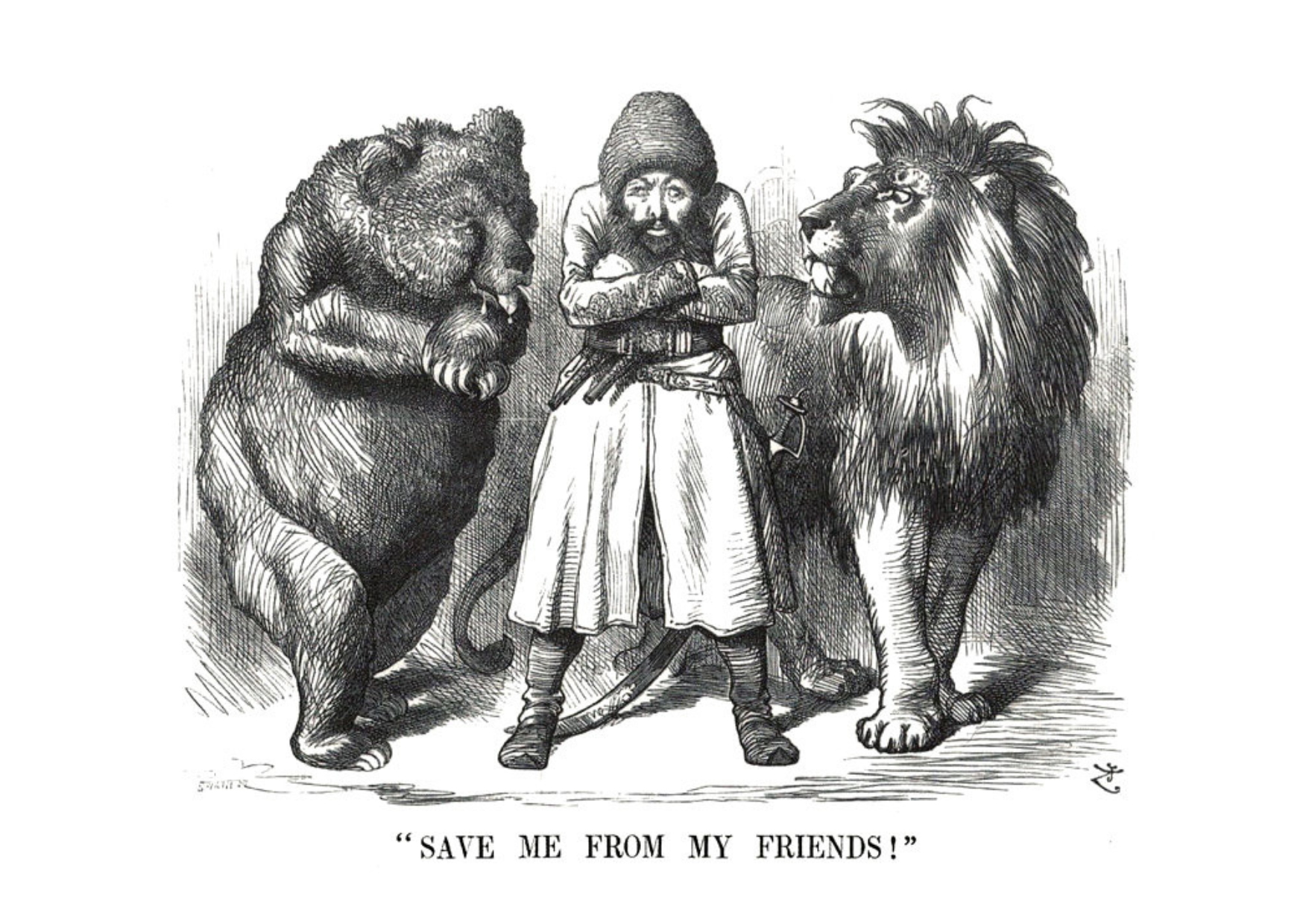
Title image credit – a cartoon originally published in Punch magazine on 30 November 1878 depicts Afghan Emir Sher Ali Khan caught between his so-called “friends,” Russia and Great Britain, illustrating the tensions of the Great Game.
The opinions expressed are those of the contributor, not necessarily of the RSAA.
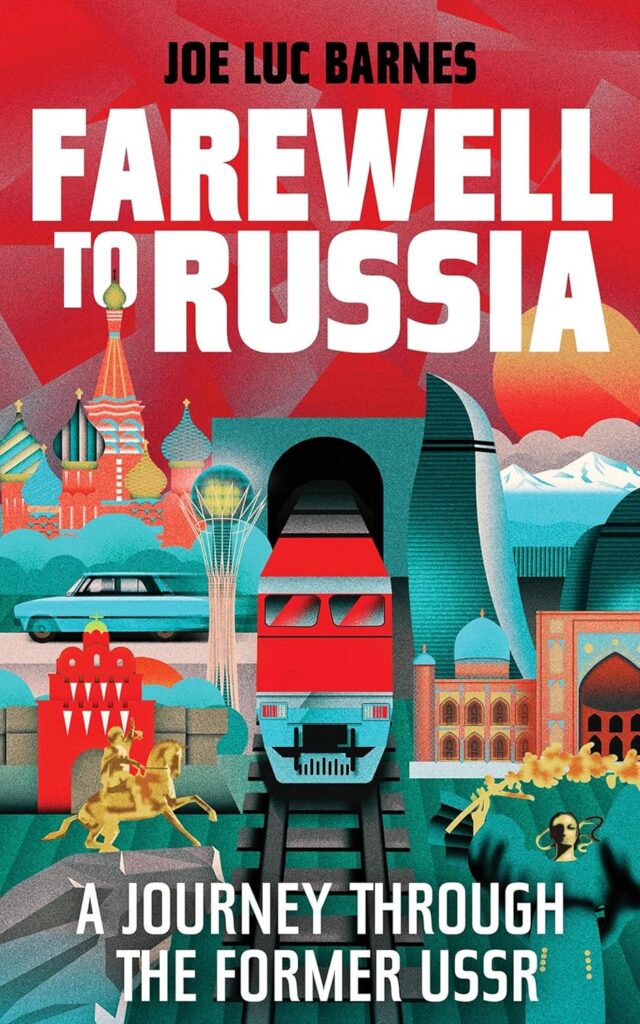
Farewell to Russia: A Journey Through the Former USSR
They may have left the Soviet Union behind – but can its former republics ever escape Russia’s shadow? More than three decades after 1991, Joe Luc Barnes travels across the ex-Soviet world, from Azerbaijan and Kazakhstan to Estonia and Uzbekistan, exploring what became of the fourteen states born from the USSR’s collapse. In the wake of Russia’s invasion of Ukraine, he meets activists, nomads, taxi drivers and others still wary of authority, uncovering how independence has reshaped – and in some ways failed to reshape – their lives. Blending humour, empathy and sharp insight, the book offers a vivid, human portrait of a region still grappling with the legacy of empire – and a warning about what happens when empires fall but their habits endure.